What happens when your fryer can no longer keep up with production—or becomes too large and costly for your needs? Choosing between a batch fryer and a continuous fryer can directly affect product consistency, oil usage, labor costs, and output.
Batch fryers provide flexibility for smaller runs and frequent product changes, while continuous fryers are designed for stable, high-volume production. The right choice depends on your product type, required capacity, available space, and operating budget.
In this article, you will learn the key differences between batch and continuous fryers, including their working methods, advantages, limitations, and ideal applications. This comparison will help you select the right frying equipment for your food production line.
Key Takeaways
Volume Dictates Architecture: Batch fryers are optimal for flexible, multi-product runs and lower throughput, while continuous fryers are engineered for uninterrupted, high-volume, single-product manufacturing.
Thermal Consistency Impacts Yield: Continuous systems offer predictable heat loads across every product layer and precise temperature control, eliminating the sharp temperature drop-off inherent in batch processing.
CapEx vs. OpEx Trade-offs: Batch systems require significantly lower upfront capital but incur higher labor and energy costs per pound of product over time compared to highly automated continuous systems.
Oil Management is Critical: Continuous fryers typically maintain a lower system oil volume relative to throughput, accelerating oil turnover and reducing free fatty acid (FFA) buildup compared to batch systems.
Product Consistency: Continuous systems guarantee uniform color, texture, and moisture retention, whereas batch systems require strict operator oversight to prevent batch-to-batch variance.
Table of Contents
Toggle
Core Requirements for Selecting Industrial Frying Machines
Before choosing between a batch fryer and a continuous fryer, food manufacturers should evaluate their production needs, product characteristics, operational flexibility, and labor resources. These factors determine which frying system can deliver consistent quality, efficient output, and sustainable operating costs.
Production Capacity: Define the required throughput in pounds per hour (lbs/hr), considering seasonal demand, shift schedules, maintenance downtime, and projected growth over the next three years.
Product Characteristics: Evaluate how the product reacts to heat, including its moisture, sugar content, coating, and required frying temperature. Kettle-style potato chips may benefit from batch frying, while extruded snacks often require the stable heat of continuous frying.
Operational Flexibility: Consider how often the line switches between products. Facilities handling multiple products need equipment that is easy to drain, clean, and refill, while dedicated lines are better suited to continuous high-volume production.
Automation and Labor: Batch fryers require more manual loading, unloading, and monitoring. Continuous fryers reduce manual work but require trained technicians to maintain sensors, pumps, and control systems.
Batch Fryers: Mechanics, Capabilities, and Limitations
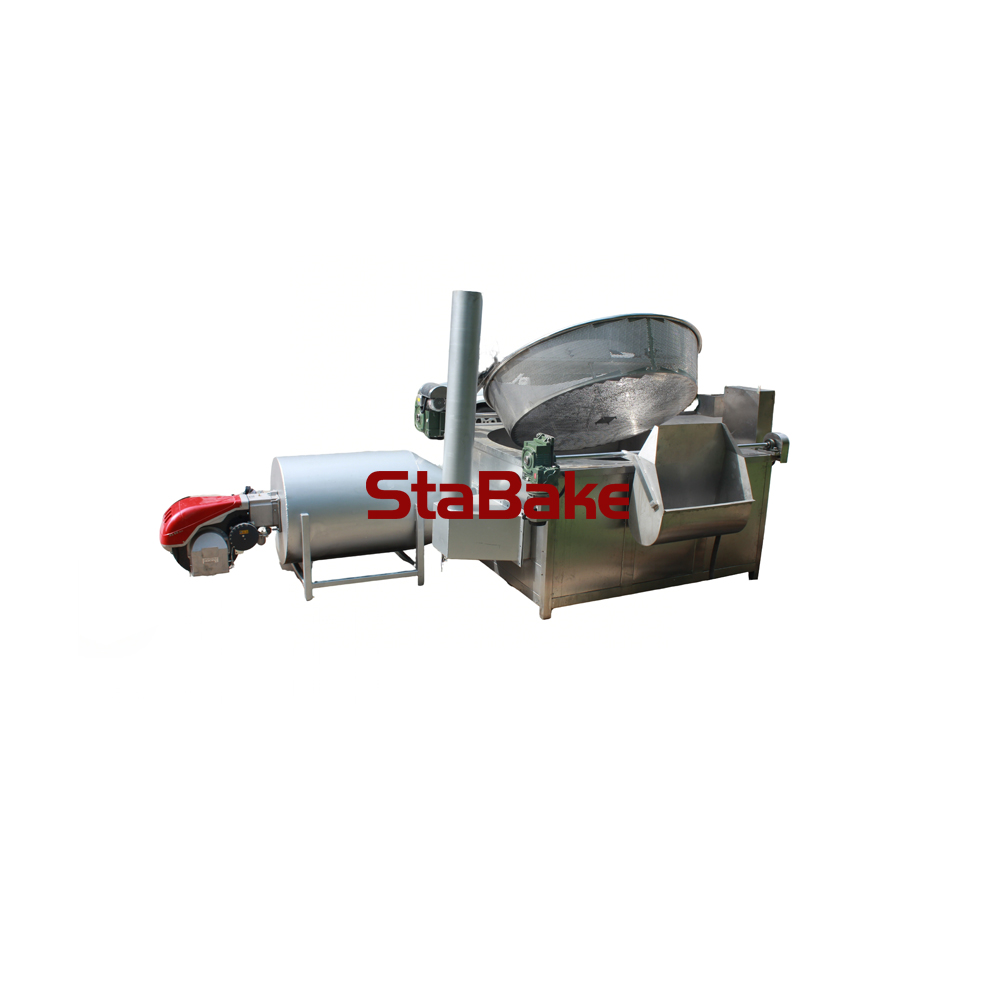
Batch fryers use a repeated loading, frying, and unloading cycle. Their changing oil temperature creates distinctive textures and provides flexibility for facilities producing multiple products, but careful process control is required to maintain consistent quality.
Working Principle: Adding cold food causes the oil temperature to drop sharply before the heating system restores it. As a result, the product cooks slowly at first and faster as the temperature recovers.
Ideal Applications: Batch fryers are suitable for artisan snacks, kettle-style chips, plantain chips, and other products that benefit from gradual moisture removal and distinctive textures.
Production Flexibility: Operators can process different products in separate batches, making the system suitable for facilities with diverse product lines or frequent changeovers.
Space Requirements: Batch fryers generally occupy less floor space and can be integrated into smaller or existing production facilities.
Potential Risks: Overloading, incorrect frying times, slow temperature recovery, and accumulated food debris can cause uneven color, excess oil absorption, undercooking, and rapid oil degradation.
Recommended Controls: Automated stirrers, load-cell dosing systems, and programmable logic controllers can improve heat distribution, standardize batch weights and frying times, and reduce operator error.
Continuous Fryers: Mechanics, Capabilities, and Limitations
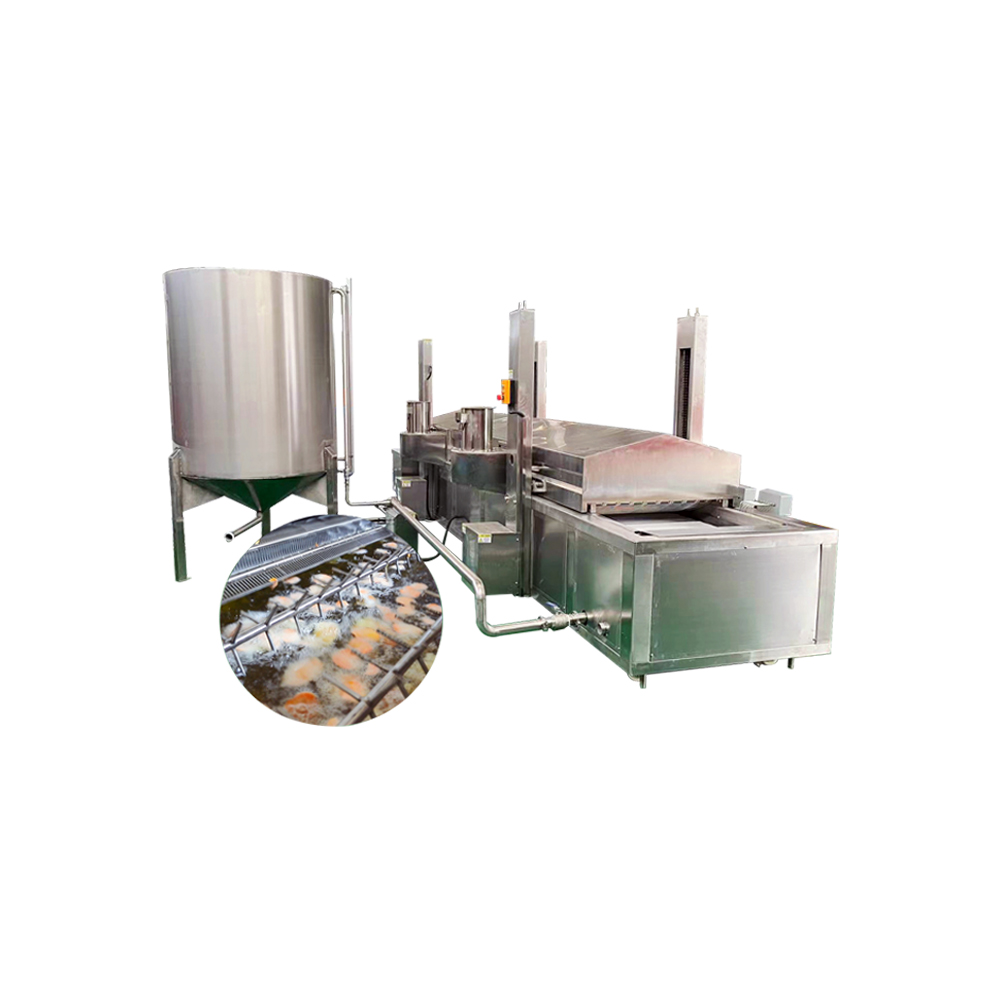
Continuous fryers use conveyor systems to move products through oil at a controlled speed and temperature. They support non-stop, high-volume production and deliver consistent frying results, but require significant investment, sufficient floor space, and advanced sanitation systems.
Working Principle: Submerged conveyor belts carry food through a heated oil trough. Belt speed controls frying time, while heat exchangers maintain a stable oil temperature.
Product Consistency: Every product receives the same frying time and thermal exposure, helping manufacturers achieve consistent color, texture, moisture, and flavor.
Ideal Applications: Continuous fryers are suitable for large factories and export-oriented processors producing french fries, extruded snacks, breaded poultry, and other standardized products.
Belt Configuration: Wire-mesh belts are suitable for sturdy products, while non-stick belts help protect delicate battered foods. Hold-down belts keep floating products submerged for even frying.
Space and Investment: These systems require higher initial investment, specialized installation, and a large production area designed for efficient linear workflow.
Cleaning Challenges: Conveyors, pumps, and heat exchangers can create areas where crumbs and oil residue accumulate, making manual cleaning difficult and time-consuming.
Recommended Controls: An automated Clean-in-Place (CIP) system can circulate cleaning solutions throughout the fryer, reducing downtime, improving food safety, and lowering manual cleaning costs.
Batch vs Continuous Fryers: Side‑by‑Side Comparison
Upfront Purchase Cost vs Long‑Term Running Expenses
The financial evaluation of industrial Food Frying Equipment extends beyond the purchase price. Batch systems offer a low barrier to entry. The initial capital expenditure is a fraction of a continuous line. This makes them highly attractive for startups and regional producers. However, the operating costs scale poorly. Batch systems demand continuous manual labor. Operators must be present for every single cycle to load, monitor, and unload the baskets. Batch fryers have fewer moving parts, meaning maintenance is generally limited to replacing thermocouples or burner components.
Continuous systems flip this financial model. The initial cost is substantial, often requiring facility modifications to accommodate the footprint. Yet, the long-term return on investment is driven by output efficiency. Continuous lines require minimal manual labor during operation. One technician can oversee a line producing thousands of pounds per hour. The labor cost per pound of finished product drops dramatically, accelerating the ROI over a multi-year horizon. Continuous systems require a dedicated maintenance budget for conveyor motors, thermal fluid pumps, and automated filtration drives.
Product Consistency and Quality Control
Batch frying inherently struggles with batch-to-batch variance. Even with automated dosing, slight variations in raw material moisture alter the temperature recovery curve. The first batch of the day might be slightly lighter in color than the last batch. Texture and moisture retention fluctuate based on how quickly the operator unloads the basket.
Continuous frying delivers strict uniformity. The heat load on each product layer is highly predictable. Because the oil temperature never drops, the moisture boils off at a constant rate. Every french fry or chicken nugget experiences the exact same thermal journey. This predictability drastically reduces quality control rejections and ensures brand consistency across millions of packages.
Energy Saving and Environmental Performance
Long-term energy consumption heavily favors continuous architecture at scale. Batch fryers lose massive amounts of heat during the loading and unloading cycles. The burners must work overtime to recover the temperature drop, wasting fuel in the process. The open-vat design also allows ambient heat to escape into the facility, increasing HVAC loads.
Continuous fryers operate in a steady state. Once the oil reaches the target temperature, the system only needs to replace the heat absorbed by the incoming product. They are generally enclosed, trapping steam and heat. Continuous systems easily integrate with heat recovery systems. Exhaust stacks capture waste heat and use it to pre-heat incoming water or facility air, maximizing overall energy efficiency.
Cooking Oil Handling and Oil Aging Issues
Cooking oil is often the highest recurring expense in a frying operation. Oil degrades through oxidation, hydrolysis, and polymerization. Batch fryers subject oil to prolonged heat stress. The turnover ratio—the time it takes for the product to absorb the total volume of oil in the fryer—is often slow. This leads to a rapid buildup of free fatty acids (FFA), resulting in dark, bitter oil that operators must discard frequently.
Continuous fryers excel at oil management. They are designed with low total system volumes relative to their high throughput. The product absorbs oil rapidly, requiring constant replenishment with fresh oil. This rapid turnover keeps the FFA levels consistently low. Continuous systems utilize continuous paper filtration or centrifugal separation to remove carbonized crumbs instantly. Paper filters catch particles down to the micron level, while centrifuges spin out heavier debris. This prevents crumbs from burning and degrading the oil quality.
Heat Performance and Predictable Heating Conditions
The heating method dictates how heat transfers to the oil. Batch fryers typically use direct gas-fired burners positioned under the vat. This creates localized hot spots on the bottom of the fryer, which can scorch the oil and degrade its lifespan.
Continuous fryers often utilize external thermal fluid heat exchangers. A separate boiler heats a thermal fluid, which then passes through tubes inside the fryer. The cooking oil flows over these tubes. This indirect heating method provides a massive surface area for heat transfer, eliminating hot spots and protecting the oil from thermal shock.
Operational Metric
Batch Frying Systems
Continuous Frying Systems
Thermal Profile
Variable (U-shaped curve)
Steady-state (Linear)
Oil Turnover Rate
Slow (Higher FFA buildup)
Rapid (Maintains oil quality)
Labor Requirement
High (Constant operator presence)
Low (Automated monitoring)
Footprint
Compact and modular
Large, linear space required
Product Changeover
Fast and flexible
Slow and complex
Filtration Integration
Manual skimming or batch filtering
Continuous automated filtration
Facility Footprint and Utility Requirements
Spatial requirements often dictate equipment selection before any other metric. Batch fryers offer a compact, modular footprint. They fit in tight corners and vent easily with standard commercial hoods. Upgrading capacity simply means placing another batch unit next to the first one.
Continuous lines require significant linear floor space. A high-capacity line stretches for dozens of feet, requiring straight-line facility layouts. They demand specialized exhaust hoods, robust fire suppression systems, and heavy-duty utility hookups for natural gas, thermal fluid, and high-voltage electricity. Facility managers must verify that their infrastructure supports these massive utility draws before procurement.
Production Expandability & Food Safety Compliance
Meeting food safety and sanitation standards is a daily operational hurdle. The realities of cleaning both systems differ vastly. Batch fryers often require labor-intensive manual cleaning. Operators must drain the oil, scrub the sidewalls, and manually flush the heating tubes. This process is time-consuming and introduces the risk of chemical residue if not rinsed properly.
Continuous systems rely on engineered CIP mechanisms. Operators connect hoses, and the system autonomously circulates boiling water and caustic chemicals through the exact same piping used for the cooking oil. This ensures that every internal surface, pump, and heat exchanger is sanitized to strict food safety standards without requiring manual scrubbing.
Maintenance & Sanitation
Batch Frying Systems
Continuous Frying Systems
Daily Cleaning
Manual draining, scrubbing, and rinsing
Automated Clean-in-Place (CIP) circulation
Debris Removal
Manual skimming between batches
Continuous automated filtration
Component Wear
Low (fewer moving parts)
High (belts, pumps, sensors)
Skill Level Required
Basic operator training
Specialized electromechanical technicians
Transitioning from batch to continuous production introduces significant operational friction. It is not simply a matter of buying larger equipment. Upgrading requires complete recipe reformulation. Because the thermal profile changes from a variable curve to a steady state, cook times and temperatures must be adjusted to match the continuous thermal profile. A product that takes eight minutes in a batch fryer might cook in three minutes on a continuous belt. The batter formulation may also need adjustment to adhere properly in a steady-state thermal environment. Staff retraining is mandatory. Operators must transition from manual handling to monitoring digital interfaces, managing automated filtration, and performing preventative maintenance on complex mechanical drives.
Conclusion
To move forward with your equipment selection and optimize your production line, execute the following steps:
Conduct a comprehensive facility audit to measure exact linear floor space and verify utility capacities for gas, water, and electrical loads.
Calculate your exact throughput requirements, factoring in a minimum of 20% growth over the next three years to prevent immediate bottlenecks.
Partner with equipment engineers to run your specific raw materials through product tests in a pilot facility to verify cook times and thermal profiles.
Analyze your local labor market to determine if staffing manual operators or hiring specialized maintenance technicians aligns better with your operating budget.
FAQ
Q: At what production volume should a facility switch from a batch to a continuous fryer?
A: Facilities typically transition to continuous systems when throughput exceeds 500 to 1,000 pounds per hour of a single product. At these volumes, the labor costs and oil degradation associated with batch processing become financially unsustainable. Continuous systems justify their high initial cost through labor reduction and higher yield at this scale.
Q: Which type of food frying equipment is more energy-efficient in the long run?
A: Continuous fryers are significantly more energy-efficient at scale. They operate in a steady state, avoiding the massive heat loss that occurs during the loading and unloading cycles of batch fryers. They also easily integrate with heat recovery systems to capture and reuse exhaust heat.
Q: Do continuous fryers use less cooking oil than batch fryers?
A: Yes, relative to their production volume. Continuous fryers are engineered with a low system oil volume. Because they process massive amounts of food quickly, the oil is absorbed and replenished rapidly. This fast turnover rate keeps the oil fresh and prevents the rapid degradation seen in batch systems.
Q: Can you cook multiple types of food in a continuous frying system?
A: While possible, it is highly inefficient. Continuous systems are designed for long, uninterrupted runs of a single product. Switching products requires draining the oil, performing a full sanitation cycle to prevent cross-contamination, and refilling the system. This causes hours of costly downtime.
Q: Why do kettle chips require a batch fryer instead of a continuous fryer?
A: Kettle chips require a specific U-shaped temperature curve. When cold potatoes hit the hot oil, the temperature drops sharply and recovers slowly. This slow cook leaches out specific starches and creates the folded shape and hard, crunchy bite that continuous steady-state fryers cannot replicate.
Q: How does the predictability of heat load affect product consistency?
A: Predictable heat loads ensure every piece of food receives the exact same thermal exposure. In continuous systems, the oil temperature remains constant, and the belt speed dictates the exact cook time. This eliminates undercooked centers, prevents greasy textures, and guarantees uniform color across every production run.