What happens when a meat processor uses the wrong machine for the desired texture? The result may be smeared fat, uneven particles, broken emulsions, and wasted production time.
Meat grinders and bowl cutters perform different roles in commercial meat processing. Grinders produce defined meat particles, while bowl cutters create finer mixtures and emulsified products.
In this article, you will learn the key differences between a meat grinder and a bowl cutter, including how they work, their ideal applications, and the factors to consider when choosing equipment for your production line.
Mechanical Distinction: Grinders utilize an auger and extrusion process for uniform particle reduction, whereas bowl cutters use high-speed rotating blades to lift, chop, mix, and emulsify in a batch format.
Product Alignment: Grinders are mandatory for coarse-ground products (burgers, traditional sausages); bowl cutters are essential for fine pastes and emulsified products (frankfurters, bologna, pâté).
Operational Flow: Grinders support continuous, inline processing, while bowl cutters operate on a batch-processing model requiring precise time, temperature, and ingredient management.
Investment Reality: Bowl cutters generally represent a higher initial capital investment and require more rigorous operator training compared to the straightforward, uniform operation of commercial meat grinders.
Table of Contents
Toggle
Working Principles of the Two Meat Processing Machines
Achieving the desired particle size dictates success in meat breakdown. You must maintain protein structure, manage pre-processing prep, and keep temperatures low. These factors prevent fat rendering during operation. Understanding the physical forces at play inside the cutting chamber ensures you select the right tool for the product.
How the Meat Grinder Works
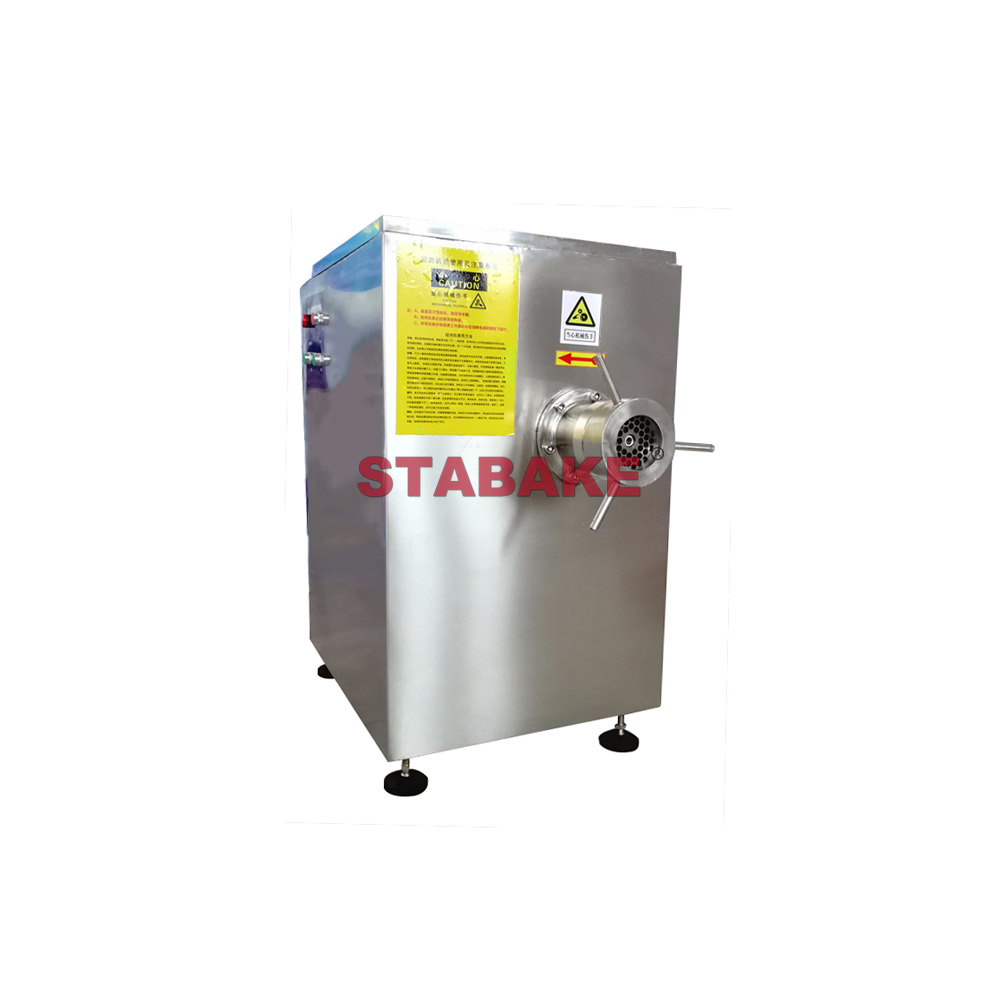
Grinders rely on a linear extrusion process. An internal auger catches chunks of meat from the hopper. It pushes this meat forward into a primary cutting blade. The machine then forces the product through a precisely sized hole plate. This system creates a clean, uniform cut. It retains the distinct structure of lean meat and fat.
The mechanical advantage of this system lies in its consistency. The hole size on the final plate strictly dictates the maximum particle size. Operators can swap plates to change the grind from a coarse chili grind to a fine sausage texture. You must pre-chunk meat to fit the hopper safely. Large primal cuts will bridge in the hopper and starve the auger. Grinders feature a continuous-feed nature. They integrate seamlessly into automated production lines. You simply feed raw material into the top, and ground product exits the front continuously.
When setting up a grinder, the tension on the retaining ring determines the cutting efficiency. Overtightening causes excessive friction between the knife and plate, leading to premature wear and heat generation. Undertightening allows sinew to wrap around the knife, which smears the fat instead of cutting it cleanly. Operators must check the sharpness of the knife and the flatness of the plate daily. A matched set wears together, ensuring a scissor-like shearing action.
How the Bowl Cutter Works
Bowl cutters utilize a dual-motion design. A horizontally rotating bowl feeds product into vertically rotating, high-speed knives. The blades actively lift and slice the meat. They do not extrude or mash the product against a fixed plate. This cutting action occurs in open air within the bowl cover. It reduces the crushing force applied to the muscle fibers.
This machine operates on a batch-processing model. You load a specific weight of meat into the bowl. The machine processes that exact batch until it reaches the desired texture. Bowl cutters incorporate water, ice, and spices directly into the matrix during the cutting phase. Proper operation requires significant skill. A trained operator visually monitors and adjusts the chop in real-time. They listen to the sound of the blades and watch the folding action of the meat batter. This provides superior texture control compared to standard Meat Processing Equipment.
The knife head configuration heavily influences the final product. You can equip the shaft with three, four, six, or even eight blades depending on the desired emulsion speed and texture. The gap between the blade edge and the bowl surface is typically set to a mere 1-2 millimeters. This tight tolerance ensures no meat escapes the cutting zone. Operators must constantly monitor the batter temperature using built-in digital thermometers. As the blades spin at up to 5000 RPM, they generate massive kinetic energy that transfers directly into the meat as heat.
Suitable Products and Final Meat Textur
Specific end-products require appropriate machinery based on texture, structural integrity, and fat-to-lean definition. You cannot force a machine to produce a texture it was not engineered to create.
When to Specify a Meat Grinder
Grinders excel at producing fresh ground beef, pork sausage, salami, and chorizo. The grinder maintains distinct fat-to-lean definition. This separation is critical for the mouthfeel, bite, and visual appeal of these products. Consumers expect to see distinct flecks of white fat against red lean meat in a premium salami. Only an extrusion-based cutting system preserves this visual contrast.
Grinders have specific mechanical limitations. They cannot create true emulsions. Running meat through a grinder multiple times will eventually turn it to mush, but it will not bind the fat and water chemically. Grinders also struggle to incorporate liquid ingredients uniformly during the grinding phase. You must use a secondary meat mixer to blend spices and water into ground meat.
For example, when producing a coarse bratwurst, you might run pork shoulder through a 3/8-inch plate. The resulting grind retains enough structural integrity to provide a satisfying snap when stuffed into a casing. If you attempt to process that same pork shoulder in a bowl cutter for too long, you lose the coarse texture entirely, resulting in a hot dog-like consistency.
When to Specify a Bowl Cutter
Bowl cutters are ideal for hot dogs, mortadella, liverwurst, and finely chopped vegetable mixtures. The high-speed blades extract myosin from the muscle. This protein acts as a natural glue. It binds meat, fat, and water into a stable, homogeneous paste. This chemical binding process is called emulsification.
The blades spin at thousands of revolutions per minute. They slice the meat cells open, releasing the salt-soluble proteins. As the bowl turns, the blades fold the fat and water into this protein matrix. Bowl cutters also serve secondary functions. Facilities use them to process doughs, cheeses, or dense vegetable matrices. They handle thick, viscous materials that would clog a standard grinder plate.
Producing a high-quality frankfurter requires a specific sequence of ingredient additions. Operators first chop the lean meat with salt and curing agents to extract the maximum amount of myosin. Once the lean meat forms a sticky paste, they add the fat trimmings and ice. The blades shear the fat into microscopic droplets while the extracted protein coats each droplet, preventing them from coalescing and rendering out during the cooking process.
The Alternative: When to Consider a Dicer Instead
Dicers offer a different approach to structural reduction. If your end goal is retaining maximum whole-muscle structure, you need a dicer. Stews, fajitas, and chunky pet foods require this structural retention. Grinders and bowl cutters focus on structural reduction and blending. They cannot maintain large, intact muscle chunks.
A dicer uses a grid of stationary blades and a slicing knife. It pushes a block of meat through the grid, shearing off perfect cubes. This leaves the muscle fibers entirely intact. You should never use a bowl cutter or a grinder if your product specification calls for distinct, chewable cubes of meat.
Key Factors to Assess Machine Performance & Food Safety
Comparing machines across critical operational metrics reveals their impact on daily facility output and product quality. You must evaluate how each machine handles volume, heat, and sanitation.
Production Capacity and Processing Speed
Commercial grinders provide continuous throughput. Facilities measure this in pounds or kilograms per hour. As long as you keep the hopper full, the machine produces ground meat. This makes grinders highly efficient for high-volume, single-product runs. You can position a conveyor belt under the discharge head to move product directly to a mixer.
Bowl cutters operate on batch capacity. Operators measure this in bowl volume or liters. A 200-liter bowl cutter can only process a specific maximum weight per cycle. Loading, monitoring, and unloading batch equipment requires dedicated labor. You must stop the machine, empty the bowl, and reload raw materials for every cycle. This batch rhythm requires careful staging of ingredients to prevent downtime between loads.
To maximize grinder throughput, facilities often install automated feed systems. A screw conveyor can deliver pre-broken meat blocks directly into the grinder hopper, eliminating manual lifting. For bowl cutters, efficiency relies on rapid loading and unloading. Mechanical dump buggies lift standard 200-liter bins and tilt them into the bowl in seconds. Unloader discs swing into the rotating bowl to plow the finished batter out into waiting vats, minimizing the time between batches.
Temperature Control and Friction Management
Friction in the auger heats the meat during extrusion. This creates a severe risk of fat smearing. Smeared fat coats the lean meat particles, preventing proper protein extraction later. Operators often semi-freeze or pre-chill meat chunks for 20 minutes. This hardens the fat prior to grinding. Cold fat shears cleanly at the plate instead of melting.
Bowl cutters generate extreme friction from high-speed blades. The mechanical energy of blades spinning at 4000 RPM transfers directly into the meat batter as heat. Operators must add flaked ice to keep the emulsion from breaking. Ice absorbs the heat through the latent heat of fusion. It prevents the fat from rendering while supplying the necessary water for the emulsion.
Facilities often utilize advanced cooling technologies. Vacuum bowl cutters remove air from the chamber, creating a denser emulsion and reducing oxidation. CO2 or Nitrogen injection systems spray cryogenic gas directly into the bowl or grinder hopper. This accelerates production safely by instantly chilling the meat matrix.
Monitoring temperature is not optional; it is a strict requirement for product safety and quality. If a sausage batter exceeds 60°F (15°C) during the chopping phase, the emulsion will likely break in the smokehouse. You will end up with fat caps on the ends of your sausages and a dry, crumbly texture.
Sanitation and Food Safety Compliance
Teardown and cleaning processes differ significantly between the two systems. Grinders require complete disassembly. You must remove the locking ring, plate, knife, and auger for thorough sanitation. Meat residue hides in the threads and behind the auger drive shaft. Operators must scrub every component individually before sanitizing.
Bowl cutters present complex sanitation requirements. Cleaning around fixed blade shafts and the bowl's curvature takes time. The knife head assembly contains multiple sharp blades positioned close together. Strict safety protocols are necessary during washdown to prevent severe lacerations. Operators must use specialized long-handled brushes to clean the blade cover and the underside of the rotating bowl.
Many modern machines feature clean-in-place (CIP) compatible designs, but manual scrubbing remains necessary for heavy protein buildup. You must inspect the seals around the bowl cutter's main drive shaft daily. A compromised seal allows meat juices to seep into the bearing housing, creating a severe biological hazard and risking mechanical failure.
Operational Trade-Offs and Facility Impact
Operational trade-offs extend beyond the mechanical cutting action. You must consider how the equipment fits into your physical plant and your maintenance schedule.
Floor Space and Utility Infrastructure Needs
Industrial grinders and bowl cutters demand different space allocations. Grinders generally offer a more compact profile for equivalent production capacities. An inline grinder takes up minimal floor space. It fits easily between a dumper and a mixer.
Bowl cutters often require a larger, dedicated footprint. The machine itself is wide to accommodate the rotating bowl. You also need clearance on all sides for loading buggies, unloading conveyors, and maintenance access. They need specific electrical configurations. High-torque motors typically require heavy-duty 3-phase power. The startup draw on a large bowl cutter motor is massive. Facilities must verify their electrical panels can handle the amperage spike.
Drainage is another critical infrastructure consideration. Bowl cutters require significant volumes of water during the washdown process. The floor beneath and around the machine must slope aggressively toward a high-capacity trench drain to prevent standing water and bacterial growth.
Maintenance and Consumables
Grinder maintenance involves regular sharpening and replacement of wear parts. Operators must replace plates and knives frequently. Running a dull knife against a grinder plate increases friction and destroys product quality. You must also monitor auger wear. A worn auger allows meat to slip backward, reducing throughput and increasing heat.
Bowl cutter maintenance is highly specialized. Balancing and sharpening multi-blade knife heads demands precision. If you sharpen one blade more than the others, the entire shaft becomes unbalanced. An unbalanced shaft vibrating at high RPM will destroy the main bearings rapidly. A blade failure at high RPM causes catastrophic machine damage. Facilities often send bowl cutter blades to specialized grinding services to ensure perfect balance and edge geometry.
Lubrication schedules dictate the lifespan of both machines. Grinder gearboxes require regular oil changes to handle the immense torque of pushing frozen meat blocks. Bowl cutter bearings require food-grade grease applied at specific intervals to survive the high-speed rotation and heavy washdown procedures.
Operational Metric
Meat Grinder (Mincer)
Bowl Cutter (Buffalo Cutter)
Primary Mechanical Action
Auger extrusion and shearing against a fixed plate
High-speed lifting and slicing in an open bowl
Production Flow Type
Continuous inline feeding
Discrete batch processing
Target End Products
Burgers, fresh sausage, salami, chorizo
Hot dogs, bologna, fine pâté, liverwurst
Ingredient Incorporation
Poor (requires secondary mixer for spices/water)
Excellent (mixes liquids and spices while cutting)
Temperature Management
Relies on pre-chilled or semi-frozen meat blocks
Requires flaked ice or cryogenic gas injection
Routine Maintenance Focus
Frequent plate and knife replacement/sharpening
Precision blade balancing and bearing lubrication
Sanitation Complexity
High (requires complete disassembly of auger/housing)
High (requires careful cleaning around sharp, fixed blades)
Project Risks and Practical Solutions
Facilities face distinct hurdles when adopting or switching machinery. Proper planning prevents production delays and ensures worker safety when integrating new Meat Processing Equipment.
Operator Training and Safety
Bowl cutters present significant safety hazards. Exposed high-speed blades require strict operational protocols. Operators must never reach into the bowl while the machine is running. Highly skilled operators must judge emulsion readiness by sight, sound, and temperature. An untrained operator can over-chop a batch in seconds, ruining hundreds of pounds of meat.
Facilities must mandate comprehensive safety training. Investing in machines with automated safety interlocks reduces risk. Modern machines will not operate if the noise cover is open. Programmable logic controllers (PLCs) standardize batch times and blade speeds. PLCs remove some of the guesswork, allowing less experienced operators to produce consistent batches based on programmed recipes.
Training should also cover emergency shutdown procedures. Every operator must know the exact location of the emergency stop buttons and how to engage the mechanical brake to halt the blade shaft instantly.
Connect New Machines to Your Current Production Line
Mismatching a batch bowl cutter with a continuous stuffer causes immediate bottlenecks. If the stuffer empties before the next batch is ready, the packaging line stops. You must calculate precise batch-cycle times. Staging areas must handle the specific output rhythm.
Dump buggies and conveyors need proper sizing to match the chosen machine. If you use a grinder, you need a continuous takeaway system. If you use a bowl cutter, you need a mechanical unloader disc to sweep the batter out of the bowl and into a waiting vat. Proper integration ensures a smooth flow of meat from the raw material cooler to the final packaging station.
Consider the physical layout of the processing room. Raw materials should flow in a straight line from the cooler, through the grinder or bowl cutter, and directly into the stuffing or forming equipment. Any backtracking or cross-traffic increases the risk of cross-contamination and slows down the overall production rate.
Troubleshooting Common Grinder Issues
Operators frequently encounter issues with product texture during the grinding process. If the ground meat appears mashed rather than cleanly cut, the primary culprit is usually a dull knife or a worn plate. You must inspect the cutting edges daily. Another common issue is fat smearing, which occurs when the meat temperature rises too high. You can resolve this by ensuring all raw materials remain properly chilled before entering the hopper. If the grinder throughput drops unexpectedly, check for sinew buildup behind the knife. Sinew wraps around the auger pin and blocks the flow of meat through the plate holes.
Troubleshooting Common Bowl Cutter Issues
Bowl cutter operators must watch for signs of emulsion breakdown. If the meat batter begins to look glossy or oily, the fat is rendering. You must immediately add more flaked ice to drop the temperature. If the final product exhibits a grainy texture, the blades may be dull, or the gap between the blades and the bowl might be too wide. Adjusting the blade clearance requires precision tools and should only be performed by trained maintenance personnel. Excessive vibration during operation indicates an unbalanced knife head. You must stop the machine immediately to prevent catastrophic bearing failure.
Optimizing Blade Configurations
The number of blades on a bowl cutter shaft directly impacts the cutting speed and the final texture. A three-blade setup works well for coarse chopping and mixing heavy doughs. A six-blade configuration provides the rapid shearing action necessary for fine emulsions like frankfurters. You must match the blade profile to the product. Straight blades offer aggressive cutting power for tough meats, while curved blades provide a smoother folding action for delicate batters. Changing the blade configuration allows a single machine to produce a wider variety of products efficiently.
Plate Selection for Meat Grinders
Grinder plates come in various hole sizes, typically ranging from 1/8 inch to 1 inch in diameter. Selecting the correct plate determines the visual appeal and mouthfeel of the final product. A 1/8-inch plate produces a fine grind suitable for breakfast sausages. A 3/8-inch plate creates the classic texture expected in a premium hamburger patty. Kidney plates feature massive, kidney-shaped holes used for the initial breakdown of large meat blocks. You often run meat through a kidney plate first, followed by a smaller plate, to reduce the strain on the machine and prevent fat smearing.
Conclusion
Audit your current product mix and projected daily volume to determine your exact capacity needs.
Measure your available floor space and verify your electrical panel capacities before selecting a machine.
Consult an equipment specialist to arrange a live product test using your specific raw materials.
Verify yield, temperature stability, and texture outcomes during the physical equipment demonstration.
Develop strict sanitation and maintenance protocols specific to the new machinery prior to installation.
FAQ
Q: Can a bowl cutter replace a meat grinder?
A: While a bowl cutter can chop meat coarsely, it cannot replicate the uniform, extruded texture of a grinder. The lifting action of the blades creates irregular particle sizes. This makes it an unsuitable replacement for traditional ground products like burgers or coarse sausages.
Q: Do I need both a grinder and a bowl cutter?
A: Facilities producing both coarse sausages and fine emulsified products will require both machines to maintain product integrity. You use the grinder for salami and fresh sausage, and the bowl cutter for hot dogs and bologna.
Q: What is a buffalo cutter?
A: A buffalo cutter is simply an alternative industry term for a bowl cutter or bowl chopper. The terms are used interchangeably in commercial meat processing to describe the same rotating-bowl machinery.
Q: Can I use a commercial food processor instead of a bowl cutter?
A: Standard food processors lack the torque, specialized lifting blade design, and cooling capabilities of true industrial machinery. Using a food processor for meat leads to mashed textures, overheated motors, and broken emulsions.
Q: Can you process frozen meat in a bowl cutter?
A: You can process frozen meat, but it requires specialized heavy-duty blades and massive motor torque to handle flaked frozen blocks. Standard bowl cutters are designed for tempered or fresh meat. Grinders equipped with frozen blocks heads handle frozen material more efficiently.
Q: Why is ice added to a meat bowl cutter?
A: Ice is necessary to counteract the intense heat generated by blade friction. The ice lowers the batter temperature, preventing the fat from rendering and the emulsion from breaking, while also providing the water needed for the recipe.