What happens when food packaging cannot keep products fresh or keep pace with production? Meat discoloration, liquid leakage, shorter shelf life, and slow packaging speeds can quickly increase product loss and operating costs.
Vacuum packaging and thermoforming packaging both protect meat and food products, but they differ in production capacity, flexibility, labor requirements, and investment costs. Choosing the right system depends on your product range, packaging volume, and available facility space.
In this article, you will learn the key differences between these two packaging methods, including how they work, their ideal applications, and their operating requirements. This comparison will help you select the right Food Packaging Machines for your production line.
Volume Dictates Architecture: Traditional vacuum packaging offers a low barrier to entry for low-to-medium volumes and highly variable product sizes, whereas thermoforming is engineered for continuous, high-volume runs of uniform products.
Consumables vs. CapEx: Thermoforming requires a significantly higher initial capital expenditure but drastically lowers per-unit material costs by utilizing rollstock film instead of pre-made pouches or pre-made rigid trays.
Retail Presentation & Storage: Thermoformed packages are precisely shaped around the product, minimizing wasted air space, offering superior structural integrity for retail display, and maximizing stackability in commercial freezers compared to standard vacuum pouches.
Facility Constraints: Thermoforming lines require substantially larger facility footprints, specialized utilities (compressed air, cooling water), and longer changeover times for different product SKUs.
Table of Contents
Toggle
Core Standards for Selecting Meat & Food Packaging Machines
Extend Shelf Life and Keep Food Stable
Removing oxygen prevents aerobic bacterial growth and lipid oxidation. This remains the absolute baseline requirement for any meat packaging operation. Fresh pork, beef, and poultry demand strict atmospheric control to survive the cold chain. Proper vacuum sealing directly reduces retail counter waste. It stabilizes the red myoglobin surface color and manages liquid purge. A tight vacuum holds the meat fibers together, preventing excess moisture from leaking out of the protein.
You must achieve a complete atmospheric evacuation to maintain product safety. Industrial pumps pull the chamber pressure down to a few millibars. Even trace amounts of residual oxygen accelerate spoilage and ruin the product. For processed meats, operators often inject a specific blend of nitrogen and carbon dioxide before sealing. This gas flush prevents the meat from crushing under the vacuum pressure while still inhibiting bacterial growth.
Package Strength and Anti-Puncture Performance
Packaging bone-in meats presents unique physical challenges on the production floor. Ribs, T-bones, and tomahawk steaks easily pierce standard plastics during transport. High-barrier, puncture-resistant films are non-negotiable here. A breached seal immediately introduces oxygen and ruins the product entirely. Operators often apply heavy-duty bone-guard cloth over sharp edges before pulling a vacuum, adding an extra layer of defense against punctures.
Your equipment must handle heavy-duty films without compromising the final seal quality. The sealing bars need sufficient pressure and heat to melt through thicker polymer layers. Polyamide-reinforced plastics provide the necessary strength but require robust heating elements to seal correctly. If the seal bar temperature drops even slightly, you will generate micro-leaks across the entire batch. Consistent pneumatic pressure on the seal anvils ensures the plastic layers fuse completely.
Production Speed and Labor Cost Control
Packages Per Minute (PPM) dictates your daily operational ceiling. Manual loading creates heavy labor dependencies on the factory floor. These dependencies directly impact overall operational efficiency and scale. You need equipment capable of matching your upstream processing line speed. Bottlenecks at the packaging stage force costly upstream slowdowns, leaving raw meat exposed to ambient temperatures for too long.
Relying on human hands to open, load, and position bags limits your maximum output. Automated systems remove this variable entirely. They ensure a consistent, predictable flow of finished goods out the warehouse door. When evaluating throughput, you must calculate the actual cycle time of the machine, including loading, evacuation, sealing, and venting. A machine that pulls a deep vacuum slowly will bottleneck your entire shift, regardless of how fast your operators can load the pouches.
Vacuum Packaging Machines: Mechanics, Capabilities, and Limitations
How Chamber Vacuum Packaging Machines Work
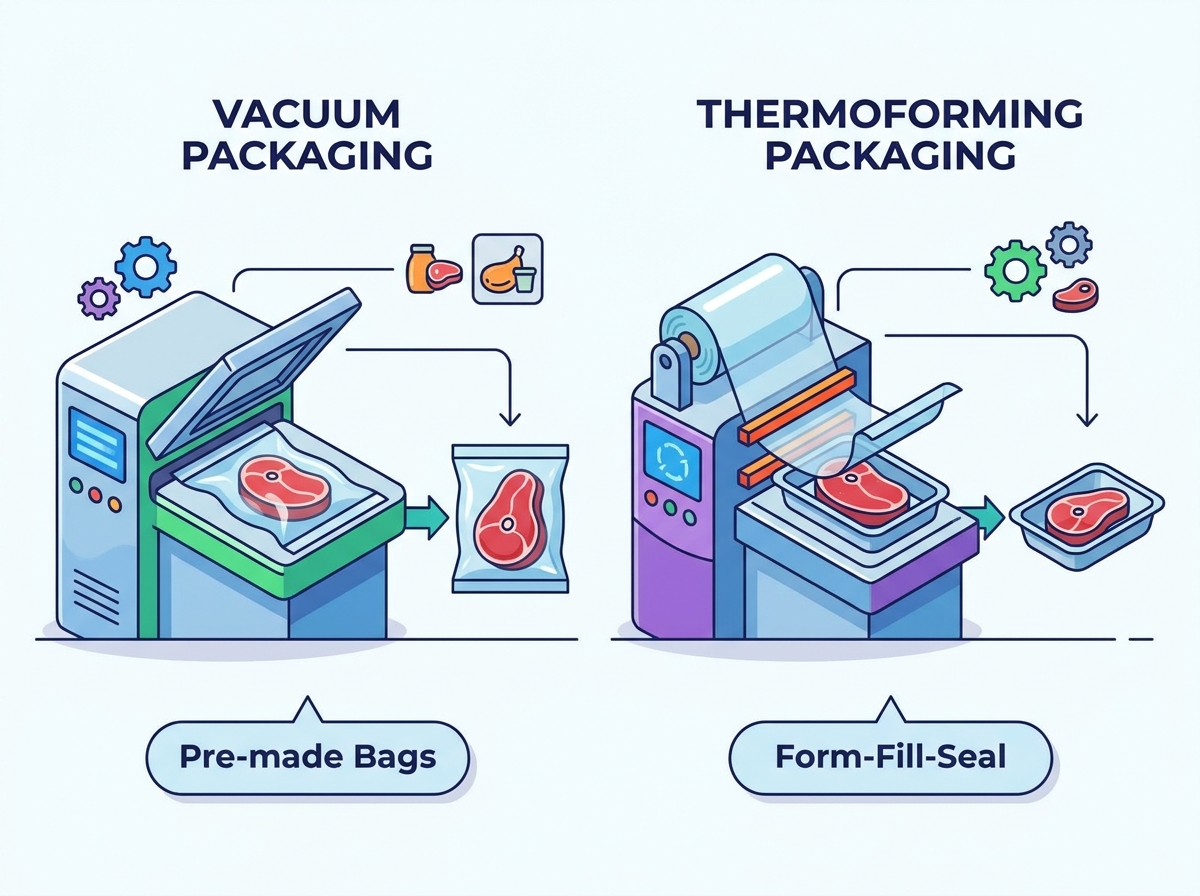
Operators place a raw product inside a pre-made plastic pouch. They lay the open end of the pouch flat across a heated sealing bar. The machine lid closes and the internal rotary vane pump evacuates the entire chamber atmosphere. This removes air from both the chamber and the inside of the pouch simultaneously. Equal pressure inside and outside the bag prevents the pouch from collapsing prematurely.
The machine then applies an electrical impulse to the sealing wire. This melts the plastic layers together to form a hermetic seal. Finally, the system releases the vacuum pressure. Ambient air rushes back into the chamber, tightly shrinking the bag around the meat. The lid opens automatically for product removal. Routine maintenance on these systems involves changing the pump oil, replacing the Teflon tape over the seal wires, and inspecting the lid gaskets for wear.
Suitable Scenarios and Product Adaptability
Chamber systems excel at handling highly variable product sizes. They easily accommodate whole primal cuts, varying cheese blocks, and custom butcher orders. You can pack a massive whole fish followed immediately by mixed batches of semi-processed foods. Switching between pouch sizes requires absolutely zero tooling changes. Operators simply grab a different sized bag from the shelf.
This makes them perfect for high-mix operations. Custom processors and seasonal game butchers rely heavily on this unmatched flexibility. You never face mechanical downtime when changing your product dimensions. Washdown procedures are also straightforward. Most standalone units feature stainless steel construction and IP65-rated electronics, allowing sanitation crews to foam and rinse the equipment quickly at the end of the shift.
Running Cost Pros and Cons
These systems offer a much lower upfront equipment cost. This creates an accessible barrier to entry for growing facilities. However, operational costs run significantly higher over time. You rely heavily on manual labor for loading pouches and positioning them on the bars. Human fatigue slows down production rates as the shift progresses. Operators must ensure the seal area remains free of blood or fat, which requires careful handling.
Furthermore, pre-made vacuum bags carry a higher per-unit cost than raw film. You pay the bag manufacturer to form the side seams. Shipping pre-made bags also means paying to transport empty air inside cardboard boxes. Managing inventory for dozens of different pouch sizes consumes valuable warehouse racking space. You must constantly monitor bag inventory to avoid shutting down a specific product line due to a stockout.
Thermoforming Food Packaging Machines: Mechanics, Capabilities, and Limitations
The Rollstock Thermoforming Process
Thermoforming operates in a highly automated, continuous sequence. The machine heats a bottom web of flat film to soften the plastic. It uses compressed air and vacuum to form a specific cavity shape inside a metal die. For deep draws, mechanical plug assists push the heated film down into the corners of the die to ensure uniform thickness. Automated loaders or human operators place the product directly into these open cavities as the web indexes forward.
The film web moves into an enclosed sealing die. The system applies a deep vacuum or gas flush. A top web of film rolls down and seals the package tightly. Finally, automated guillotine blades and rotary knives perform cross and longitudinal cutting to separate the packs. A rewinder collects the excess skeleton film waste. This continuous motion requires precise web tracking to keep the top and bottom films aligned perfectly.
Precision Shaping and Retail Optimization
Thermoforming shapes the package precisely around the meat or protein. This reduces wasted air space significantly. It creates a rigid, retail-ready presentation like cups, tubs, or structured trays. Thermoformers create the tray in-line directly from raw rollstock film. This eliminates the need to purchase and inventory pre-made rigid trays. Consumers prefer the clean, professional look of a thermoformed package.
The tight contouring prevents the meat from shifting around during transit. It also provides a large, flat top surface for automated label application. You can utilize printed top webs with registered eye-marks to align branding perfectly on every single pack. The structural rigidity of the formed bottom web protects delicate products like sliced deli meats or soft cheeses from getting crushed during palletization.
Cost Analysis for High-Volume Production
Installing a continuous line requires high upfront capital expenditure. The return on investment depends entirely on high-speed continuous output. You achieve this through drastically reduced labor headcount. One operator can manage a machine producing thousands of packs per hour. The machine sets the pace of production, eliminating the variability of human fatigue.
Raw rollstock film also costs significantly less than pre-made pouches. You buy plastic by the mile instead of by the piece. High daily volumes justify the initial equipment investment rapidly. The material savings alone often pay for the machine in high-throughput environments. Storing rolls of film requires a fraction of the warehouse space compared to pallets of pre-made bags, freeing up square footage for revenue-generating activities.
Vacuum Machine vs Thermoformer: Side-by-Side Comparison
Production Expandability and Output Speed
Rotary or double-chamber vacuum machines operate as batch processes. This fundamentally limits their maximum throughput. An operator must wait for the cycle to finish before loading the next batch. Double-chamber models allow operators to load one side while the other side pulls a vacuum, but the output remains capped by the pump speed and manual loading times.
Thermoformers utilize a continuous web flow. They produce dozens of packages simultaneously per cycle. The film advances, seals, and cuts without stopping. High-volume facilities depend on this continuous flow to meet strict daily quotas. A chamber machine might peak at a few cycles per minute. A thermoformer easily quadruples that output while requiring fewer human operators on the line.
Technical Feature
Vacuum Chamber Machines
Thermoforming Lines
Throughput (PPM)
Low to Medium (Batch Process)
Very High (Continuous Flow)
Material Format
Pre-made Pouches
Raw Rollstock Film
Product Flexibility
Extremely High (Instant changeover)
Low (Requires physical die changes)
Labor Dependency
High (Manual bag loading)
Low (Automated indexing)
Facility Footprint
Compact / Standalone
Extensive / Linear (15+ feet)
Utility Demands
Standard Electrical
3-Phase Power, Chilled Water, High CFM Air
Material Waste and Package Optimization
Film utilization varies wildly between the two methods. Thermoforming trims waste and optimizes the exact fit around proteins. The machine cuts the plastic precisely at the seal edge. The only waste generated is the thin skeleton trim along the edges of the web, which the machine automatically rewinds for recycling.
Standard vacuum bags often leave excess plastic tails. Operators must use a bag slightly larger than the meat to ensure it fits over the sealing bar without wrinkling. These tails look sloppy and waste valuable material. Rollstock allows precise control over package dimensions. You only use the exact amount of plastic required to enclose the product safely, driving down your per-unit packaging cost.
Pallet Storage Efficiency and Cold Chain Transport
Post-packaging footprint heavily impacts your cold chain efficiency. Uniform, rigid thermoformed packs offer superior stackability. They maximize storage efficiency in master cartons and commercial freezers. You can pack more units onto a single pallet. Consumers also find them easier to stack in home fridges.
Irregular vacuum pouches waste valuable pallet space. They slide around and create uneven layers inside shipping boxes. This instability often requires extra corrugated dividers or stretch wrap to secure the pallet. Maximizing logistics density lowers your freight costs and improves warehouse utilization. When you ship dense, uniform cartons, you maximize the weight capacity of your refrigerated trailers.
Facility Footprint and Utility Requirements
Standalone vacuum chambers feature a highly compact nature. They fit easily into tight processing rooms. You can mount them on casters and roll them away for washdown. They typically only require a standard electrical connection. Some larger models might need a small compressed air line for the seal bar cylinders, but the demands remain minimal.
Thermoforming lines demand an extensive linear footprint. They often stretch twenty feet across the factory floor. They also require heavy-duty electrical drops and dedicated chilled water systems to cool the sealing plates and forming dies. High-capacity compressed air is mandatory to form the film cavities and actuate the cutting knives. You must upgrade your facility utilities before installing a continuous line.
Factory Space and Supporting Utility Needs
Upfront Purchase Cost and Asset Depreciation
Evaluating the upfront costs requires looking at a standard 5-to-10-year depreciation schedule. Vacuum chambers represent a minor capital outlay. You can often purchase them out of an annual maintenance budget. They depreciate quickly, but their mechanical simplicity means they outlast their depreciation schedule easily. You will replace pumps and seal bars, but the heavy stainless steel chassis lasts decades.
Thermoformers require a massive initial capital injection. You are buying a highly engineered, multi-station automated line. You must factor in the cost of the machine, the specialized die sets, the utility upgrades, and the installation rigging. However, the depreciation of this asset offsets the massive reduction in daily operating expenses. The financial model must account for the labor savings and material cost reductions over a five-year horizon.
Consumables: Pre-made Pouches vs. Rollstock Film
You must calculate the break-even point where the volume of packaging justifies the switch to rollstock film. Pre-made pouches carry a heavy premium. You pay for the material, the manufacturing of the pouch, the packaging of the pouches, and the shipping of empty space. As your daily volume climbs into the thousands, this premium becomes a massive financial drain.
Rollstock film arrives in dense, heavy rolls. You pay strictly for the polymer weight. The cost per square inch of rollstock is a fraction of a pre-made pouch. To find your break-even point, map your current annual spend on pre-made bags against the projected cost of rollstock for the exact same volume. Factor in the reduced freight costs and the reclaimed warehouse space.
Maintenance, Downtime, and Changeover Speeds
Thermoforming introduces hidden costs through expensive tooling and mechanical downtime. Different package sizes require dedicated metal die sets. Swapping these heavy dies requires a skilled mechanic. You must shut the machine down, unbolt hot metal plates, install the new forming tools, and recalibrate the film tracking.
Lock out and tag out the machine power.
Disconnect the chilled water lines from the forming and sealing dies.
Remove the top and bottom die plates using a mechanical lift.
Install the new die configuration and reconnect the pneumatics.
Thread the new width of rollstock film through the tension rollers.
Run test cycles to verify seal integrity and cavity depth.
This changeover process can take an hour or more. Compare this to the near-instant changeover of a vacuum chamber, where an operator simply grabs a different bag. You must factor this mechanical downtime into your overall equipment effectiveness (OEE) calculations.
Common Packaging Challenges and Practical Solutions
Operator Training and Technical Complexity
Thermoformers introduce significant technical complexity to the processing floor. They require skilled technicians to manage film tracking and tension. Heating temperatures and seal integrity need constant monitoring. A slight temperature drop causes micro-leaks across an entire batch. If the web tracking drifts, the cutting knives will slice into the seal area, ruining the packages.
You must invest heavily in OEM training for your maintenance staff. Establish strict Standard Operating Procedures to prevent costly downtime. Operators must understand how to read HMI error codes and adjust pneumatic pressures. Vacuum chambers require almost zero technical training to operate effectively. A new hire can learn to load and seal a vacuum pouch in five minutes.
Adapting to Product Line Variations
Expensive thermoforming dies lock you into specific package dimensions. Changing sizes takes time and halts production completely. If your sales team introduces a new product size that doesn't fit your existing dies, you face a lead time of several weeks and a heavy invoice to machine a new die set.
Conduct a thorough SKU rationalization audit before purchasing equipment. Ensure your selected die configurations cover the vast majority of your production volume. Consolidate your package sizes to minimize changeovers. Keep a small vacuum chamber on the floor to handle edge cases and oversized custom cuts. This hybrid approach protects your continuous line from unnecessary stops while maintaining flexibility for custom orders.
Conclusion
Conduct a comprehensive facility utility audit to verify your electrical, chilled water, and pneumatic capacities before ordering continuous lines.
Request an operational efficiency analysis from equipment manufacturers based on your specific daily film usage and labor rates.
Run sample product tests on demo machines to verify seal integrity, puncture resistance, and retail presentation.
Perform an SKU rationalization audit to consolidate package dimensions and minimize required die changes.
FAQ
Q: What is the main difference between vacuum packaging and thermoforming?
A: Vacuum packaging uses pre-made pouches in a manual batch process. Operators load bags individually before the machine evacuates and seals them. Thermoforming forms packages directly from rolls of flat film in a continuous, automated process. It heats the film, shapes the tray, loads the product, and seals it inline without stopping.
Q: Which food packaging machines are best for fresh bone-in meat?
A: Vacuum chamber machines are generally preferred for highly irregular, sharp cuts. Operators can apply heavy-duty bone-guard cloth and use thick pouches to prevent sharp ribs from puncturing the plastic. Thermoforming handles bone-in meats well only if you equip the machine with specialized high-barrier, puncture-resistant rollstock film.
Q: Does thermoforming packaging also use a vacuum?
A: Yes. Thermoforming refers to how the package cavity is created from raw film. Once the product is loaded into the formed cavity, these machines integrate vacuum and gas-flush capabilities. This removes oxygen before the top web seals the package, slowing spoilage and keeping the food safe.
Q: At what production volume should a facility switch to a thermoforming machine?
A: Facilities typically switch when manual pouch loading becomes a severe labor bottleneck. A general industry benchmark is several thousand units per day. At this scale, the massive savings on raw rollstock film compared to pre-made pouches quickly offset the higher initial equipment costs.
Q: Can a thermoforming machine handle multiple package sizes?
A: Yes, they handle multiple sizes. However, doing so requires purchasing different metal die sets. Swapping these heavy dies requires scheduling mechanical downtime for changeovers and recalibrating the machine. This makes thermoformers less ideal for constant size switching compared to vacuum chambers.