Introduction
How much does a French Fries Production Line really cost? Many buyers feel unsure before investing. Price varies widely based on capacity and setup.
In this article, you will learn key cost factors, equipment details, and how to choose the right production line for your needs.
What Is a French Fries Production Line and What Does It Include?
Core Equipment in a French Fries Production Line
A standard French Fries Production Line includes several key machines. Each machine performs a defined function. Proper coordination between equipment ensures uniform product quality and efficient operation.
Washing and peeling machine
Removes soil and potato skin simultaneously through brush rotation and water flow. High efficiency helps reduce raw material loss. Clean surface preparation improves downstream processing quality.
Cutting machine (adjustable fry size)
Cuts potatoes into uniform strips using adjustable blades. Size control ensures consistency across batches. Uniform thickness leads to even frying and better texture.
Blanching machine for color protection
Uses controlled hot water treatment to prevent oxidation. Maintains natural color and internal structure. Improves product appearance and final taste.
Dewatering and air drying system
Removes surface moisture using vibration and high-pressure airflow. Reduces frying time and energy consumption. Helps avoid oil splashing during frying.
Continuous frying machine
Maintains stable temperature and frying duration. Ensures even cooking across all product pieces. Directly influences crispness and flavor.
Deoiling and cooling system
Reduces excess oil through centrifugal force or airflow. Improves mouthfeel and product quality. Cooling stabilizes structure before seasoning.
Seasoning and packaging system
Applies seasoning evenly through rotating drums or spray systems. Packaging equipment fills, seals, and optionally injects nitrogen. Extends shelf life and protects product integrity.
Complete Processing Flow of French Fries Production
The production process follows a structured sequence. Each stage prepares the product for the next operation. Stable processing ensures consistent product quality and efficient output.
Raw potato → washing → peeling → sorting
Cutting → rinsing → blanching
Dewatering → drying → frying
Deoiling → cooling → seasoning → packing
In industrial applications, conveyors connect each stage. Continuous operation improves efficiency and reduces manual handling. A well-designed French Fries Production Line ensures stable production, consistent quality, and optimized processing performance.
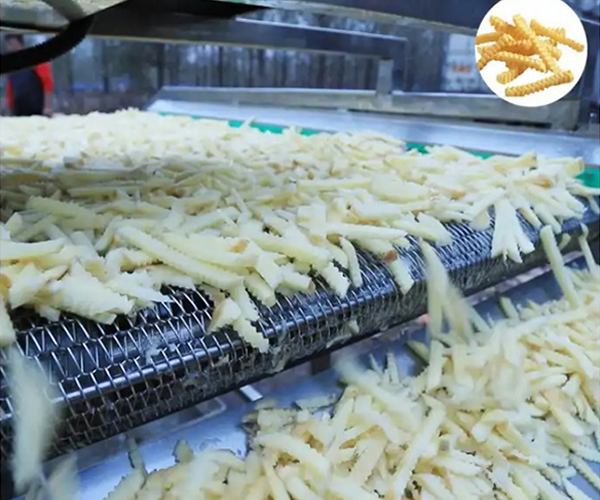
What Factors Affect the Cost of a French Fries Production Line?
Production Capacity and Output Requirements
Production capacity is one of the most critical cost drivers. Higher output requires larger machines, stronger systems, and more advanced configurations. Equipment size, energy consumption, and processing speed all increase as capacity grows.
Small scale (50–100 kg/h)
Suitable for startups or small food businesses. Lower investment makes entry easier. Production remains flexible but limited in output.
Medium scale (150–500 kg/h)
Fits growing businesses or regional suppliers. Balanced investment and output. Provides better efficiency and stability.
Large scale (1000 kg/h and above)
Designed for industrial production. Requires continuous processing systems. Higher cost comes with higher productivity and automation.
Capacity also determines equipment size and layout. Larger lines need more space, stronger conveyors, and higher power supply.
| Capacity Level | Output Range | Typical Use Case | Cost Impact |
| Small | 50–100 kg/h | Startup production | Low investment |
| Medium | 150–500 kg/h | Commercial expansion | Moderate investment |
| Large | 1000+ kg/h | Industrial manufacturing | High investment |
Automation Level and Labor Requirements
Automation level directly affects both upfront cost and long-term expenses. Choosing between semi-automatic and fully automatic systems changes labor demand, efficiency, and return on investment.
Semi-automatic systems
Require manual operation at several stages. Lower initial cost makes them attractive for small businesses. Higher labor dependency increases long-term operating cost.
Fully automatic systems
Use continuous processing and automated control. Reduce human intervention. Improve consistency and production speed.
Automation also improves stability. Consistent temperature control, conveyor speed, and processing timing reduce product variation.
Product Type and Processing Complexity
Product type has a strong influence on equipment requirements. Different production goals lead to different process designs.
Fresh French fries production
Simpler process flow. Fewer processing steps required. Lower equipment investment.
Frozen French fries production
Requires stricter processing control. Additional steps increase complexity. Equipment configuration becomes more advanced.
Frozen fries production usually includes more precise temperature control and additional processing stages. That increases both equipment cost and system complexity.
Higher complexity leads to higher investment. However, frozen products often have higher market value.
Material, Energy System, and Customization
Material selection and system configuration also affect the final price. These factors influence durability, operating cost, and long-term performance.
Stainless steel construction
Improves hygiene and corrosion resistance. Extends equipment lifespan. Higher-grade materials increase initial cost but reduce maintenance.
Electric vs gas heating system
Electric heating offers easier installation. Gas heating reduces energy cost in large-scale production. Choice depends on local energy conditions.
Customized design and layout
Production lines often require adjustments based on factory space. Custom conveyors, machine arrangement, and control systems may be needed. Customization increases cost but improves efficiency.
Careful evaluation of these factors helps optimize investment. A well-matched configuration improves efficiency and reduces long-term costs.
How Much Does a French Fries Production Line Cost?
Estimated Cost by Production Scale
Production scale is the most direct factor influencing price. Larger capacity requires bigger machines, higher energy consumption, and more advanced systems.
Small-scale line: $30,000 – $80,000
Suitable for startups or small food processing businesses. Equipment configuration remains relatively simple. Manual operation may still be required in some stages.
Medium-scale line: $80,000 – $200,000
Designed for growing businesses with stable demand. Offers better automation and higher efficiency. Suitable for regional supply.
Large-scale line: $200,000 – $500,000+
Built for industrial production. Continuous processing and full automation are common. Requires higher investment but delivers maximum output and efficiency.
A clearer comparison is shown below:
| Production Scale | Capacity Range | Estimated Cost | Typical Application |
| Small | 50–100 kg/h | $30,000 – $80,000 | Startup or small factory |
| Medium | 150–500 kg/h | $80,000 – $200,000 | Commercial production |
| Large | 1000+ kg/h | $200,000 – $500,000+ | Industrial manufacturing |
Higher capacity increases both equipment size and system complexity. That leads to higher total cost.
Cost Breakdown of Equipment and System Components
A French Fries Production Line consists of multiple systems. Each system contributes to the total cost. Understanding the breakdown helps buyers allocate budget more effectively.
Processing machines cost
Includes washing, peeling, cutting, blanching, and drying equipment. These machines form the foundation of the production line. Quality and material selection affect price significantly.
Frying system cost
Represents one of the most expensive parts of the line. Continuous frying machines require precise temperature control. Heating method also impacts cost.
Packaging system cost
Covers weighing, filling, sealing, and optional nitrogen flushing. Advanced packaging improves shelf life and product quality. Fully automatic systems increase investment.
Control system and automation cost
Includes control panels, sensors, and automation software. Higher automation reduces labor but increases initial cost.
Additional Costs Beyond Equipment Price
Equipment price is only part of the total investment. Several additional costs must be considered during project planning.
Installation and commissioning
Includes equipment setup, system testing, and adjustment. Technical support ensures stable operation. On-site service may increase cost but reduces risk.
Factory setup (water, electricity, drainage)
Production lines require stable utilities. Proper infrastructure ensures smooth operation. Initial setup cost depends on existing facilities.
Operator training and maintenance
Skilled operators are essential for efficient production. Training improves performance and reduces errors. Regular maintenance extends equipment lifespan.
Additional cost considerations include:
Spare parts and consumables
Energy consumption during operation
Future expansion or upgrades
These costs are often underestimated. However, they play a critical role in long-term profitability. Careful planning helps avoid unexpected expenses and ensures stable production.
How to Choose the Right French Fries Production Line for Your Budget?
Matching Production Line to Business Goals
A French Fries Production Line should match the business model. Different goals require different configurations. A mismatch can lead to wasted investment or limited growth.
Startup vs industrial production
Small startups usually need flexible and lower-cost solutions. Semi-automatic lines often fit early-stage businesses. Industrial production requires continuous systems with higher stability and output.
Local market vs export market
Local supply focuses on fresh or short shelf-life products. Export markets require consistent quality and longer shelf life. Packaging and process control become more important in export scenarios.
Scalability considerations
Production demand may increase over time. A scalable system allows future upgrades. Modular design helps expand capacity without replacing the entire line.
Balancing Cost, Efficiency, and Product Quality
Cost should never be the only decision factor. A low-cost system may reduce initial investment but increase long-term risk. A balanced approach ensures stable production and consistent quality.
Avoiding over-investment or under-capacity
Oversized equipment increases unnecessary cost. Undersized systems limit production capacity. Proper planning helps match equipment to real demand.
Importance of stable frying and drying processes
Frying temperature and drying performance directly affect product texture. Poor control leads to uneven quality. Stable systems improve consistency and reduce waste.
Ensuring consistent product quality
Uniform cutting, controlled blanching, and precise frying are essential. Consistency improves brand reputation. Reliable equipment helps maintain quality across batches.
Practical Tips Before Purchasing a Production Line
Before purchasing a French Fries Production Line, careful preparation is necessary. Clear planning reduces risk and improves decision quality.
Define capacity clearly
Production targets should be realistic. Daily and hourly output must be calculated. Accurate capacity planning prevents underperformance or waste.
Evaluate supplier support and service
Technical support plays a critical role. Installation guidance, training, and maintenance services improve system reliability. Strong support reduces downtime.
Consider long-term operating costs
Energy consumption, labor, and maintenance should be evaluated. A lower purchase price does not always mean lower total cost. Operating efficiency affects profitability.
Additional practical points include:
Factory layout planning before equipment purchase
Utility availability such as water and electricity
Spare parts availability and maintenance planning
A well-prepared purchase decision improves efficiency, reduces risk, and ensures smooth production from the beginning.
Conclusion
French Fries Production Line cost depends on capacity, automation, and process design. Careful planning improves efficiency and product quality. Star Bake offers flexible solutions, reliable equipment, and strong support services, helping businesses achieve stable production and long-term value.
FAQ
Q: What is a French Fries Production Line?
A: A French Fries Production Line processes potatoes into fries through washing, cutting, frying, and packaging.
Q: How much does a French Fries Production Line cost?
A: A French Fries Production Line typically costs $30,000 to $500,000 depending on capacity and automation.
Q: How to choose a French Fries Production Line?
A: Choose a French Fries Production Line based on output, budget, and product type.
Q: Why automation matters in a French Fries Production Line?
A: Automation improves efficiency, reduces labor, and ensures stable product quality.
Q: What affects French Fries Production Line price most?
A: Capacity, automation level, and processing complexity impact total cost the most.


