Introduction
Is your production line limiting your growth? Choosing the right Potato Chips Production Line can change everything. Many businesses struggle to match capacity with efficiency. In this article, you will learn how to select the right line based on output, equipment, and long-term goals.
Understanding Production Capacity in a Potato Chips Production Line
What Does Production Capacity Mean in Potato Chips Processing?
When we talk about production capacity in a Potato Chips Production Line, we usually refer to how many kilograms of finished chips can be produced per hour. This value is typically expressed in kg/h, such as 100 kg/h or 300 kg/h. Capacity defines not only output, but also factory layout, machine size, and workflow design.
Another key factor behind capacity is the raw material conversion ratio. In most cases, potato chips production follows a standard relationship between fresh potatoes and final product:
Raw Material Ratio – Fresh Potato to Chips Conversion
Production commonly follows a 4:1 ratio, meaning four kilograms of fresh potatoes produce one kilogram of chips. This ratio affects raw material planning, storage capacity, and upstream processing equipment.
Output Planning – Hourly vs Daily Production
Capacity should be calculated not only per hour but also across working shifts. For example, an 8-hour shift at 200 kg/h results in 1600 kg of daily output, which directly impacts supply planning.
Equipment Impact – Machine Size and Throughput Matching
Higher capacity requires larger washing, peeling, and frying systems. If upstream and downstream machines are not matched, production flow becomes unstable and inefficient.
Capacity also determines how the production line is structured. Smaller systems may use compact layouts and partial manual operation, while larger systems rely on continuous conveying and automated control systems.
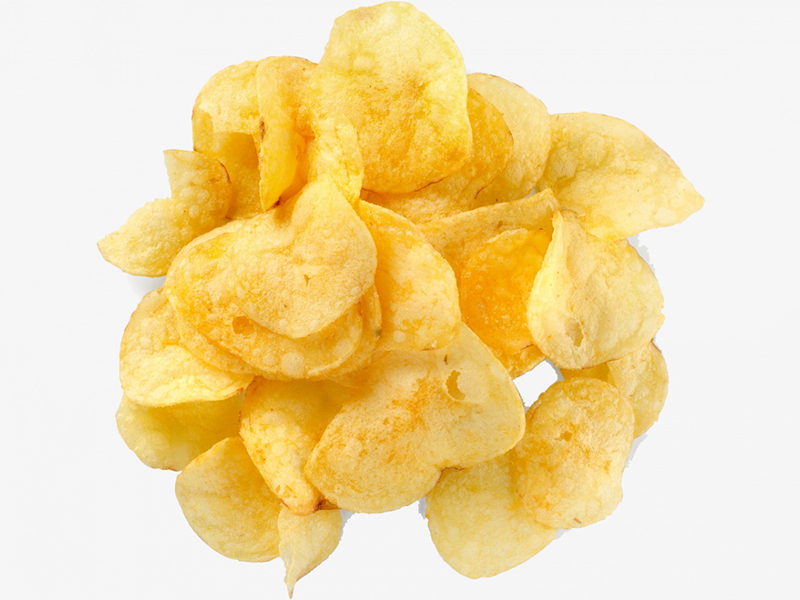
Small, Medium, and Large Capacity Potato Chips Production Line Options
Different production capacities are designed for different business stages. Choosing the right scale helps balance investment, efficiency, and long-term growth. Star Bake provides multiple capacity options, allowing flexible configuration based on real production needs.
Small Capacity Line – Entry-Level Production
A small-capacity Potato Chips Production Line typically ranges from 50 to 100 kg/h. This type of setup is suitable for startups or pilot production. Investment is lower, equipment footprint is smaller, and operation can remain semi-automatic. This allows businesses to test market demand while keeping financial risk under control.
Medium Capacity Line – Scalable Business Growth
A medium-capacity line usually operates between 150 and 300 kg/h. This level supports growing businesses that require higher efficiency and more stable output. Automation increases at this stage, reducing labor dependency and improving product consistency. It is ideal for regional distribution and expanding product lines.
Large Capacity Line – Industrial Continuous Production
Large-capacity systems start from 500 kg/h and can reach up to 2000 kg/h or more. These lines are designed for continuous operation with high automation. They require more advanced layout planning, stronger utilities, and higher raw material supply. However, they significantly reduce unit production cost and improve overall efficiency.
Below is a clear comparison of different capacity levels:
| Capacity Level | Output Range (kg/h) | Automation Level | Typical Use Case |
| Small | 50–100 | Semi-automatic | Startup, pilot production |
| Medium | 150–300 | Partial automatic | Growing business, regional supply |
| Large | 500–2000+ | Fully automatic | Industrial scale, continuous production |
Key Equipment and Process Flow in a Potato Chips Production Line
Complete Processing Flow from Raw Potato to Finished Chips
A complete Potato Chips Production Line follows a structured process that transforms fresh potatoes into finished packaged chips. Each stage plays a specific role in product quality, efficiency, and consistency. Star Bake provides a full-process solution that integrates all key steps into one continuous workflow.
The standard processing flow includes:Washing → Peeling → Cutting → Blanching → Dewatering → Frying → Seasoning → Packaging
Cleaning Stage – Washing and Peeling Preparation
Washing removes soil and impurities from raw potatoes, while peeling ensures a clean surface for slicing. This stage directly affects hygiene and product appearance, especially for uniform chip color.
Shaping Stage – Cutting and Thickness Control
Cutting machines slice potatoes into uniform chips, typically around 1.5–2 mm thick. Consistent thickness ensures even frying and stable product texture.
Pre-Treatment Stage – Blanching and Dewatering
Blanching helps prevent oxidation and preserves color, while dewatering removes surface moisture. This step reduces oil splashing and improves frying efficiency.
Thermal Processing Stage – Frying and Flavor Development
Frying at controlled temperatures creates the final texture and taste. Stable heat distribution ensures consistent product quality across batches.
Final Stage – Seasoning and Packaging
Seasoning systems distribute flavor evenly, while packaging—often with nitrogen filling—protects chips from breakage and extends shelf life.
Another key decision in this stage is choosing between continuous and batch production:
Continuous Production – Stable Output Flow
Continuous systems run without interruption, ensuring consistent product quality and higher efficiency. This approach is more suitable for medium and large capacity lines.
Batch Production – Flexible but Lower Efficiency
Batch systems process chips in cycles, allowing flexibility for small-scale production. However, output stability and efficiency are lower compared to continuous systems.
Core Machines in a Potato Chips Production Line and Their Functions
A Potato Chips Production Line is built from multiple machines, each designed for a specific function. Understanding these machines helps buyers evaluate performance, efficiency, and product quality.
Washing and Peeling Machine – Raw Material Preparation
This machine cleans and peels potatoes using brush systems. It combines two processes into one, improving efficiency while minimizing material loss.
Cutting Machine – Precision Thickness Control
Cutting equipment determines chip size and thickness. Adjustable blades allow producers to control product specifications and adapt to market preferences.
Frying System – Temperature and Oil Management
The frying machine is the core of the line. It offers adjustable temperature control, often between 0–220°C, along with oil filtration systems. Stable frying ensures uniform color, texture, and taste.
De-Oiling, Seasoning, and Packaging System – Final Product Quality
De-oiling reduces excess oil for better taste and lower greasiness. The seasoning machine ensures even flavor distribution, while packaging systems automate filling, sealing, and nitrogen injection for product protection.
These machines work together as an integrated system. If one stage is not optimized, the entire production flow can be affected.
How Equipment Configuration Changes with Different Capacities
Equipment configuration in a Potato Chips Production Line changes significantly based on production capacity. As output increases, the system becomes more automated, continuous, and integrated.
Feeding System – Manual vs Automated Handling
Small-capacity lines often use manual feeding or simple conveyors. Larger systems use automatic feeding conveyors and elevators to ensure stable and continuous input of raw potatoes.
Frying Method – Batch vs Continuous Frying Systems
Batch fryers are common in small lines due to lower cost and flexibility. Continuous frying systems are used in medium and large lines to maintain constant temperature and improve output consistency.
System Integration – Drying, Cooling, and Conveying Coordination
Higher-capacity lines integrate air drying, cooling, and conveying systems into a seamless process. This reduces downtime, improves efficiency, and ensures smooth product flow between stages.
Here is a comparison of configuration differences across capacities:
| Configuration Aspect | Small Capacity Line | Medium Capacity Line | Large Capacity Line |
| Feeding System | Manual / simple conveyor | Semi-automatic conveyor | Fully automatic feeding system |
| Frying System | Batch frying | Semi-continuous frying | Continuous frying system |
| Process Integration | Basic | Partially integrated | Fully integrated system |
| Efficiency Level | Moderate | Improved | High efficiency, stable output |
As production capacity increases, the focus shifts from flexibility to efficiency and stability. A well-configured Potato Chips Production Line ensures that every stage—from washing to packaging—works together smoothly without bottlenecks.
How to Choose the Right Potato Chips Production Line Based on Capacity
Selecting Automation Level: Semi-Automatic vs Fully Automatic
Choosing the automation level in a Potato Chips Production Line directly affects investment, labor, and production stability. Different capacities often require different automation strategies, so the decision should align with both budget and long-term production goals.
Cost Balance – Investment vs Labor Expenses
Semi-automatic lines require lower initial investment, which makes them suitable for startups or small-scale production. However, labor costs remain higher due to manual operations. Fully automatic lines require higher upfront cost, but they reduce long-term labor expenses and improve overall cost efficiency.
Production Stability – Consistency and Output Control
Fully automatic systems deliver more stable production because machines operate continuously with controlled parameters. Semi-automatic lines rely more on manual handling, which may lead to variations in output and product quality.
Application Fit – Choosing Based on Business Stage
Semi-automatic lines are ideal for trial production or limited capacity operations. Fully automatic lines are better suited for medium to large capacity production, where efficiency, consistency, and scalability become critical.
The comparison below helps clarify the differences:
| Factor | Semi-Automatic Line | Fully Automatic Line |
| Investment Level | Lower | Higher |
| Labor Requirement | Higher | Lower |
| Production Stability | Moderate | High |
| Suitable Capacity | Small scale | Medium to large scale |
| Expansion Ability | Limited | Strong scalability |
Matching Potato Chips Production Line to Your Product Type
A Potato Chips Production Line should match not only production capacity but also product type. Different chip styles and product categories require specific equipment settings and configurations.
Product Category – Standard vs Specialty Chips
Standard potato chips require stable slicing and frying conditions. Specialty chips, such as plantain or cassava chips, may require adjustments in slicing, blanching, and frying parameters. A flexible production line allows switching between different products without major changes.
Thickness Control – Impact on Texture and Quality
Chip thickness is typically controlled between 1.5–2 mm. Thinner chips fry faster and become crispier, while thicker chips may require longer frying time. Adjustable cutting machines are essential to maintain consistent product quality.
Multi-Product Capability – Expanding Product Range
A well-designed line can process multiple raw materials, including potato, plantain, taro, cassava, and sweet potato. This flexibility helps manufacturers adapt to market demand and introduce new products without investing in separate production lines.
Selecting a line that supports multiple product types increases long-term value and reduces the need for future upgrades.
Raw Material Requirements and Their Impact on Line Selection
Raw material quality plays a critical role in the performance of a Potato Chips Production Line. Even advanced equipment cannot compensate for unsuitable raw potatoes. Understanding these requirements helps ensure stable production and consistent product quality.
Physical Characteristics – Size, Shape, and Internal Quality
Potatoes should have a diameter of about 40–60 mm with a regular shape. A uniform structure allows consistent slicing and reduces waste during processing.
Chemical Properties – Dry Matter and Sugar Content
Dry matter content should be around 22–25%, while reducing sugar content should remain below 0.2%. These factors directly influence frying color, texture, and taste.
Storage Condition – Pre-Processing Preparation
Potatoes should be stored at 12–18°C for about one week before processing. Proper storage helps stabilize internal composition and improves processing performance.
Below is a quick reference for raw material requirements:
| Parameter | Recommended Range | Impact on Production |
| Diameter | 40–60 mm | Uniform slicing, less waste |
| Dry Matter Content | 22–25% | Better texture and crispiness |
| Sugar Content | ≤ 0.2% | Prevents dark color during frying |
| Storage Temperature | 12–18°C (1 week) | Improves processing stability |
Poor raw material quality can lead to uneven frying, excessive oil absorption, or inconsistent product appearance. For this reason, selecting the right Potato Chips Production Line should always be combined with proper raw material control.
Cost, Efficiency, and Supplier Support Considerations
Initial Investment vs Long-Term Operating Cost
When selecting a Potato Chips Production Line, focusing only on the purchase price can be misleading. A lower-cost line may seem attractive at first, but long-term operating costs often have a bigger impact on profitability. Star Bake emphasizes both low initial investment and efficient operation, which helps balance these factors.
Equipment Cost – Upfront Investment Planning
Initial cost includes core machines such as washing, cutting, frying, and packaging systems. Smaller or semi-automatic lines reduce upfront investment, but may require more labor and manual control during production.
Energy Consumption – Power and Heating Efficiency
Energy usage depends heavily on frying systems, heating methods, and drying equipment. Efficient designs reduce electricity or gas consumption, especially in continuous production environments where machines run for long hours.
Oil Management – Usage and Filtration Systems
Frying oil is a major recurring cost. Systems with automatic filtration and temperature control help extend oil life, reduce waste, and maintain product quality.
Maintenance Planning – Spare Parts and Service Life
Regular maintenance is essential for stable production. Machines with simple structure and easy access to spare parts reduce downtime and maintenance cost over time.
Energy Efficiency and Production Stability
Efficiency in a Potato Chips Production Line is closely linked to how well each stage is controlled. Stable production ensures consistent product quality and reduces waste, especially in medium and large capacity operations.
Temperature Control – Consistent Frying Performance
Advanced frying systems allow precise temperature adjustment, often within a wide range. Stable heat ensures uniform color and texture, avoiding overcooking or undercooking.
Water Removal – Dewatering and Air Drying Efficiency
Removing excess moisture before frying is critical. Efficient dewatering and air drying reduce oil splashing, shorten frying time, and improve final taste.
Process Continuity – Smooth Production Flow
Continuous operation improves efficiency by reducing interruptions. Integrated conveying, cooling, and processing systems allow materials to move smoothly through each stage.
System Coordination – Balanced Equipment Performance
Each machine must match the capacity of the others. If one stage becomes a bottleneck, overall efficiency drops. A well-designed line ensures all stages operate in harmony.
Installation, Training, and After-Sales Support
Supplier support is a critical factor when choosing a Potato Chips Production Line, especially for new projects or capacity upgrades. Strong support reduces setup time and helps operators quickly adapt to the equipment.
Installation Options – Remote Guidance vs On-Site Support
Suppliers may offer online or telephone guidance for installation and commissioning. For more complex setups, on-site engineers can assist with installation, system testing, and initial operation.
Operator Training – Skill Development and Efficiency
Proper training ensures operators understand machine operation, wiring, and maintenance. Well-trained staff can reduce errors, improve efficiency, and extend equipment life.
Technical Support – Troubleshooting and Maintenance Assistance
Reliable after-sales service helps resolve technical issues quickly. Support may include remote troubleshooting, spare parts supply, and maintenance guidance.
Startup Assistance – Faster Production Readiness
With structured support, production lines can reach stable operation faster. This reduces downtime and allows businesses to begin production and generate revenue sooner.
Choosing a supplier that provides clear installation guidance, structured training, and ongoing technical support ensures that the Potato Chips Production Line operates efficiently from the very beginning.
Conclusion
Selecting the right Potato Chips Production Line depends on capacity, automation, and raw material quality. Star Bake provides flexible solutions with complete processing systems, stable performance, and strong support, helping manufacturers improve efficiency, ensure product quality, and achieve scalable production growth.
FAQ
Q: What is a Potato Chips Production Line?
A: A Potato Chips Production Line is a system that processes potatoes into chips through washing, cutting, frying, and packaging.
Q: How to choose a Potato Chips Production Line capacity?
A: Choose capacity based on market demand, daily output, and future expansion needs.
Q: Why is automation important in a Potato Chips Production Line?
A: Automation improves efficiency, reduces labor cost, and ensures stable product quality.
Q: What affects Potato Chips Production Line performance?
A: Raw potato quality, equipment configuration, and process control all affect performance.
Q: How much does a Potato Chips Production Line cost?
A: Cost depends on capacity, automation level, and machine configuration.


