Introduction
Buying a French Fries Production Line can feel confusing, especially with many options available. This article explains the key factors that affect performance and cost. You will learn how to choose a system that improves efficiency, ensures quality, and supports your business growth.
1. Production Capacity and Output Planning for a French Fries Production Line
How to calculate the required capacity for your French Fries Production Line
Before selecting a French Fries Production Line, we need to clearly define how much product we want to produce per day. Many buyers focus only on machine capacity, but that often leads to mismatches. It is better to start from market demand, then work backward to determine the required hourly output.
A practical way is to break down production into smaller steps:
Estimate daily sales volume and working hours
Convert daily demand into hourly capacity
Add a safety margin for peak demand or downtime
For example, if a factory plans to produce 800 kg of finished fries per day and runs 8 hours, the minimum capacity should be around 100 kg/h. However, adding a buffer is important because real production always includes losses and interruptions.
Another key factor is the raw potato to finished product ratio. In most cases, the conversion is around 4:1. This means:
400 kg raw potatoes → about 100 kg finished fries
Water loss and peeling waste account for a large portion
Raw material planning directly affects production stability
We should always calculate both raw input and final output together. Ignoring this often leads to supply issues or underutilized equipment.
Capacity Planning Example
| Daily Target (Finished) |
Working Hours |
Required Capacity (kg/h) |
Raw Potato Needed (kg/day) |
| 400 kg |
8 hours |
50 kg/h |
1600 kg |
| 800 kg |
8 hours |
100 kg/h |
3200 kg |
| 1600 kg |
8 hours |
200 kg/h |
6400 kg |
This table helps visualize how quickly raw material demand increases. It also shows why capacity planning must be realistic and data-driven.
Available capacity ranges and scalability options
A French Fries Production Line is usually available in multiple capacity levels. Choosing the right range depends on business size, labor availability, and investment budget. Instead of jumping to the largest system, it is better to match the line to current needs while leaving room for growth.
We can generally divide capacity into three levels:
Small-scale lines (50–100 kg/h)
Suitable for startups or local supply. Lower investment, easier operation. However, expansion may be limited if demand grows quickly.
Medium-scale lines (150–500 kg/h)
Ideal for growing businesses. Balanced investment and output. Often chosen by companies entering regional markets.
Large-scale lines (500–2000 kg/h)
Designed for industrial production. Higher automation level. Requires stable raw material supply and stronger infrastructure.
Star Bake offers flexible configurations across these ranges. It allows businesses to select a system that fits current production while preparing for future expansion. The ability to switch between semi-automatic and fully automatic setups also adds flexibility.
Scalability is another important consideration. A good French Fries Production Line should allow:
Adding extra modules later
Upgrading automation level
Expanding packaging or frying sections
We should not lock ourselves into a system that cannot grow. A slightly higher initial investment often brings better long-term flexibility.
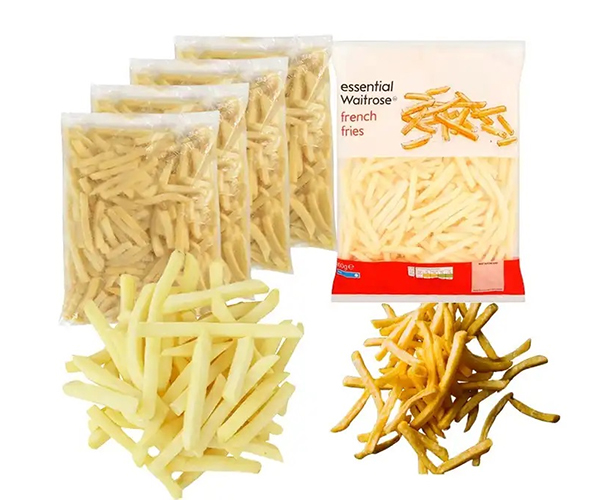
2. Raw Material Requirements and Product Quality Control
What kind of potatoes are suitable for French fries production
Choosing the right raw potatoes is the first step in building a stable French Fries Production Line. Many production issues actually come from raw material inconsistency rather than machine performance. If the potato quality varies, the final fries will show uneven color, texture, and taste.
Size and Shape Requirements
Potatoes should have a regular shape and medium size, typically around 40–60 mm in diameter. Uniform size helps ensure consistent peeling and cutting. Irregular shapes increase waste and reduce efficiency during processing.
Internal Quality and Freshness
Potatoes should have a clean white interior and minimal sprouting. Excessive buds or defects will affect both appearance and taste. It is also important to store potatoes under controlled temperature before processing to stabilize their internal condition.
Dry Matter and Sugar Content
Dry matter content should be in a suitable range, usually around 22–25%. Higher dry matter leads to better texture and crispiness. At the same time, sugar content must remain low, otherwise fries may become too dark during frying. Proper raw material selection helps reduce defects later in the process.
Key processing steps that affect product quality
Even with good raw potatoes, poor processing control can still lead to inconsistent products. A French Fries Production Line must handle each step carefully to maintain quality.
Washing and Peeling Efficiency
Washing removes dirt and impurities, while peeling must be thorough but gentle. Efficient brush washing systems can clean and peel at the same time, reducing loss while improving productivity. Poor peeling leaves defects that affect appearance.
Cutting Precision and Uniformity
Cutting is one of the most critical steps. Blade adjustment determines the final size and shape of fries. If cutting is uneven, some pieces will overcook while others remain undercooked. Precision cutting ensures consistent frying results.
Blanching for Color Protection
Blanching helps prevent oxidation and maintains the natural color of potatoes. It also removes excess starch, which improves frying performance. Without proper blanching, fries may turn dark or develop uneven texture.
Controlling thickness, texture, and appearance
Final product quality depends heavily on consistency. Small variations in thickness or moisture can lead to noticeable differences after frying.
Uniform Thickness Control
Fries or chips should maintain a consistent thickness, such as 1.5–2 mm for chips or standard sizes for fries. Uniform thickness ensures even heat transfer during frying and prevents quality defects.
Texture and Crispiness Balance
Proper drying and frying create the desired texture. If moisture is not controlled well, fries may become too soft or overly oily. A balanced process helps achieve a crispy outside and soft inside.
Visual Appearance and Market Acceptance
Color, shape, and surface smoothness all affect how customers perceive the product. Consistency across batches builds brand trust and reduces rejection rates in the market.
3. Frying System and Oil Management in a French Fries Production Line
Why the frying system is the core of the production line
In any French Fries Production Line, the frying section plays a central role. It directly determines how the final product looks, tastes, and feels. Even if earlier steps are well controlled, poor frying performance can still ruin product quality.
Impact on Taste, Color, and Crispiness
Frying defines the final sensory quality. Proper temperature creates a golden color and crispy texture. If temperature fluctuates, fries may turn too dark or remain pale and soft.
Stability of Frying Conditions
Consistent frying temperature ensures every batch cooks evenly. Unstable conditions cause variation between batches, which is a common issue in low-quality systems. Stable frying helps maintain uniform product standards.
Heat Transfer and Process Efficiency
Efficient heat transfer reduces frying time and improves throughput. A well-designed frying system ensures that each piece is evenly exposed to heat, avoiding undercooked or overcooked sections.
Key features to evaluate in frying equipment
When selecting a French Fries Production Line, the frying machine should be evaluated carefully. It is not just about heating oil; it is about maintaining control throughout the process.
Adjustable Temperature Range
A wide temperature range, such as 0–220°C, allows flexibility for different products. Different raw materials require slightly different frying conditions. Adjustable control helps adapt to these needs.
Heating Method Selection
Frying systems typically offer electric or gas heating. Electric heating provides precise control and is easier to manage. Gas heating is often more cost-efficient for large-scale production. The choice depends on factory conditions and energy costs.
Automatic Temperature Control and Filtration
Advanced systems include automatic temperature regulation and built-in filtration. These features help maintain stable oil quality and reduce manual intervention. Continuous filtration also removes residues that could affect product quality.
Oil control, filtration, and cost efficiency
Oil management is one of the most important cost factors in a French Fries Production Line. Poor oil control not only increases expenses but also reduces product quality and hygiene standards.
Reducing Oil Consumption and Waste
Efficient systems minimize oil loss during frying and de-oiling stages. Proper oil circulation and filtration extend oil life. This directly reduces operating costs over time.
Preventing Contamination and Residue Build-up
Food particles and starch residues can accumulate in oil. Without proper filtration, these impurities burn and affect taste and color. Continuous removal of residues keeps the oil clean and stable.
Maintaining Hygiene and Product Safety
Clean oil ensures better food safety and consistent quality. A well-designed frying system supports easy cleaning and prevents cross-contamination. This is essential for meeting food processing standards.
4. Automation Level and Equipment Configuration
Semi-automatic vs fully automatic French Fries Production Line
When selecting a French Fries Production Line, automation level is one of the most practical decisions. It directly affects labor cost, production efficiency, and operational complexity. Many buyers underestimate how much automation influences long-term profitability.
Labor Requirements and Daily Operation
Semi-automatic lines require more manual work, especially in feeding, sorting, and transferring materials. This may reduce initial investment but increases labor dependency. Fully automatic lines reduce manual intervention, allowing fewer operators to manage the entire process.
Production Efficiency and Consistency
Fully automated systems maintain stable speed and consistent output. They reduce human error and improve product uniformity. Semi-automatic lines may experience fluctuations due to manual handling.
Choosing Based on Budget and Factory Scale
Smaller businesses often start with semi-automatic lines to control costs. As production demand increases, upgrading to a fully automatic French Fries Production Line becomes more efficient. The right choice depends on production goals and available resources.
Automation Level Comparison
| Type |
Labor Requirement |
Production Stability |
Initial Investment |
Suitable For |
| Semi-Automatic |
Higher |
Moderate |
Lower |
Small factories/startups |
| Fully Automatic |
Lower |
High |
Higher |
Medium to large factories |
Complete process flow and system integration
A French Fries Production Line is not just a collection of machines. It is a continuous system where each step must connect smoothly. Poor integration often leads to bottlenecks, product damage, or inefficiency.
Full Processing Flow Overview
A standard line follows a sequence: washing → peeling → sorting → cutting → rinsing → blanching → dewatering → drying → frying → deoiling → cooling → seasoning → packing. Each step prepares the product for the next stage.
Importance of Smooth Material Transfer
Conveyors and elevators play a key role in maintaining flow. If materials are not transferred smoothly, production may slow down or cause damage to the fries. Continuous flow ensures stable output and better product quality.
Reducing Bottlenecks and Downtime
A well-integrated system balances the speed of each machine. If one machine runs slower than others, it creates a bottleneck. Proper system design ensures that all sections operate in harmony.
Key equipment included in a standard production line
Understanding the main equipment helps buyers evaluate whether a French Fries Production Line is complete and efficient. Each machine has a specific role in ensuring product quality.
Pre-processing Equipment (Washing and Peeling)
These machines clean and remove the potato skin. Efficient washing and peeling reduce waste and prepare potatoes for uniform cutting.
Cutting and Blanching Systems
Cutting machines determine the shape and size of fries. Blanching helps maintain color and removes excess starch. Together, they ensure consistent appearance and texture.
Drying, Frying, and Deoiling Units
Drying reduces surface moisture before frying. Frying creates the final texture and color. Deoiling removes excess oil, improving taste and reducing greasiness.
Cooling, Seasoning, and Packaging Machines
Cooling stabilizes the product after frying. Seasoning ensures even flavor distribution. Packaging protects the product and prepares it for storage or sale.
Each piece of equipment must work together as a system. A well-configured French Fries Production Line ensures smooth operation, consistent quality, and efficient production.
5. Packaging System, Hygiene Standards, and After-Sales Support
Packaging requirements for French fries products
Packaging is not just the final step in a French Fries Production Line. It directly affects product shelf life, appearance, and customer satisfaction. Many buyers focus on frying quality but overlook packaging performance, which can lead to breakage or shorter storage time.
Automatic Packing Systems for Efficiency
Modern production lines use automatic packing systems to handle weighing, filling, sealing, and coding. It reduces manual work and improves consistency. When production volume increases, manual packing becomes inefficient and error-prone. Automated systems ensure stable speed and reduce product loss during handling.
Nitrogen Filling for Product Protection
Nitrogen flushing is a key feature in advanced packaging systems. It replaces oxygen inside the package, helping prevent oxidation and moisture absorption. This keeps fries crisp for a longer time. It also reduces breakage during transport by maintaining internal pressure inside the bag.
Packaging Consistency and Market Presentation
Uniform packaging improves product appearance and brand image. It also ensures each bag contains the correct weight. Consistency builds trust in the market and reduces complaints from distributors or retailers.
Packaging System Features Comparison
| Feature |
Basic Packaging System |
Advanced System (Star Bake) |
| Packing Method |
Manual/Semi-auto |
Fully automatic |
| Weight Accuracy |
Variable |
High precision |
| Nitrogen Filling |
Not available |
Integrated |
| Production Efficiency |
Lower |
High |
| Product Protection |
Limited |
Strong |
Hygiene design and cleaning convenience
Hygiene is a critical factor in any food processing system. A French Fries Production Line must be designed to meet food safety standards while also allowing easy cleaning. Poor hygiene design leads to contamination risks and longer downtime.
Easy-to-Clean Equipment Structure
Equipment should be designed for quick cleaning and maintenance. Smooth surfaces and removable parts help operators clean faster. If machines are difficult to access, cleaning becomes time-consuming and often incomplete.
Oil Residue and Waste Management
Frying produces oil residue and food particles. These must be removed efficiently to prevent buildup. Systems should include proper drainage and filtration to keep the production environment clean. Poor residue management can affect both hygiene and product quality.
Food Safety and Compliance Requirements
Production lines must meet food safety standards in different markets. Clean design reduces contamination risk and helps maintain consistent product quality. Buyers should always consider whether the equipment supports long-term compliance.
Installation, training, and technical support
Even the best French Fries Production Line cannot perform well without proper installation and operator knowledge. Support services play a key role in ensuring smooth startup and long-term operation.
Installation Options and Setup Flexibility
Suppliers may offer remote guidance or on-site installation. Remote support is faster and cost-effective. On-site service provides hands-on assistance and ensures accurate setup. The choice depends on project complexity and customer experience.
Operator Training and Skill Development
Operators need to understand how the system works. Training includes machine operation, troubleshooting, and basic maintenance. Well-trained staff can reduce downtime and improve production efficiency.
Ongoing Technical Support and Maintenance
Continuous support helps solve problems quickly. It also ensures the system runs efficiently over time. Regular guidance on maintenance can extend equipment lifespan and reduce unexpected failures.
A reliable supplier like Star Bake provides installation guidance, training support, and technical assistance. This helps businesses start production smoothly and maintain stable operation over time.
Conclusion
Choosing the right French Fries Production Line depends on capacity, raw materials, frying control, automation, and packaging. Star Bake provides flexible solutions, stable frying systems, and reliable support. It helps improve efficiency, product quality, and long-term production value.
FAQ
Q: What is a French Fries Production Line?
A: A French Fries Production Line is a system that processes potatoes into fries through washing, cutting, frying, and packing.
Q: How to choose the right French Fries Production Line capacity?
A: Select a French Fries Production Line based on daily output needs, working hours, and future expansion plans.
Q: Why is frying important in a French Fries Production Line?
A: Frying controls taste, color, and texture, making it the most critical step in a French Fries Production Line.
Q: How much does a French Fries Production Line cost?
A: French Fries Production Line cost depends on capacity, automation level, and configuration of equipment.
Q: What are the benefits of an automatic French Fries Production Line?
A: An automatic French Fries Production Line improves efficiency, reduces labor, and ensures consistent product quality.


