Introduction
How do manufacturers produce consistent frozen fries at scale? A French Fries Production Line makes it possible. It connects key processes into one system. In this article, you will learn how it works and how to choose the right solution.
What Is an Automatic French Fries Production Line and How Does It Work
What Defines a Fully Automatic French Fries Production Line
A fully automatic French Fries Production Line is designed to run continuously from raw potato input to finished product output. It integrates multiple processing stages into one connected system. Operators do not need to intervene at every step. Instead, the system controls feeding, processing speed, temperature, and product transfer automatically. This improves consistency and reduces labor intensity across the factory.
We can understand it better by comparing different levels of automation:
| Type of Production Line | Key Characteristics | Labor Requirement | Output Stability |
| Manual Line | Independent machines, disconnected workflow, frequent manual handling | High | Low |
| Semi-Automatic Line | Partial automation, some conveyors and control systems | Medium | Moderate |
| Fully Automatic French Fries Production Line | Continuous processing, integrated control, minimal manual input | Low | High |
A fully automatic system allows smoother material flow. It reduces human error. It also ensures each batch follows the same process parameters. For frozen food manufacturers, this matters a lot. Consistent output helps meet strict quality standards and large-scale production demand.
Key features that define automation in a French Fries Production Line include:
Continuous conveying system that moves potatoes between stages without interruption. This avoids delays and improves overall efficiency.
Centralized control of temperature, frying time, and processing speed. It ensures stable product quality across long production runs.
Integrated equipment layout that connects washing, cutting, frying, and packing into one streamlined workflow.
These features make the system suitable for industrial use. It supports large output volumes while maintaining uniform quality.
Core Processing Stages in a French Fries Production Line
A standard French Fries Production Line follows a clear and logical sequence. Each stage is designed to prepare the product for the next step. The process starts with raw potatoes and ends with finished fries ready for packaging or freezing.
Below is a simplified flow structure based on industrial processing logic:
Feeding → Washing & Peeling → Sorting → Cutting
Rinsing → Blanching → Dewatering → Air Drying
Frying → De-oiling → Cooling → Seasoning → Packaging
Each stage plays a specific role in achieving the final product quality. Let’s break down the core stages and what they do.
| Processing Stage | Function | Impact on Product |
| Washing & Peeling | Removes dirt and skin from potatoes | Ensures hygiene and clean surface |
| Cutting | Shapes potatoes into uniform strips | Controls size and cooking consistency |
| Blanching | Uses hot water to stabilize color and texture | Prevents oxidation and discoloration |
| Drying | Removes surface moisture before frying | Improves frying efficiency and reduces oil splashing |
| Frying | Cooks fries at controlled temperature | Develops texture, color, and flavor |
| De-oiling | Removes excess oil after frying | Reduces greasiness and improves taste |
| Packaging | Packs product with optional nitrogen filling | Extends shelf life and protects structure |
The transition between stages is just as important as the stages themselves. A well-designed line ensures smooth transfer between machines. It avoids product damage and maintains uniform processing conditions.
To better understand how the process flows in real production, consider these operational details:
Washing and peeling are often combined into one machine. It saves space and increases efficiency. It also reduces product loss during handling.
Blanching temperature and time are carefully controlled. This step helps maintain the natural color of potatoes. It also prepares them for frying.
Air drying uses high-pressure airflow. It quickly removes moisture and shortens frying time. This improves both efficiency and product texture.
Frying systems are usually equipped with automatic temperature control. They maintain stable oil conditions and ensure even cooking.
De-oiling and cooling help stabilize the product before packaging. They reduce oil content and prevent sticking or breakage.
These stages work together as a system. When one stage performs well, the next stage becomes more efficient. That is why a fully integrated French Fries Production Line is preferred for frozen food manufacturers. It delivers better control, higher output, and more consistent product quality.
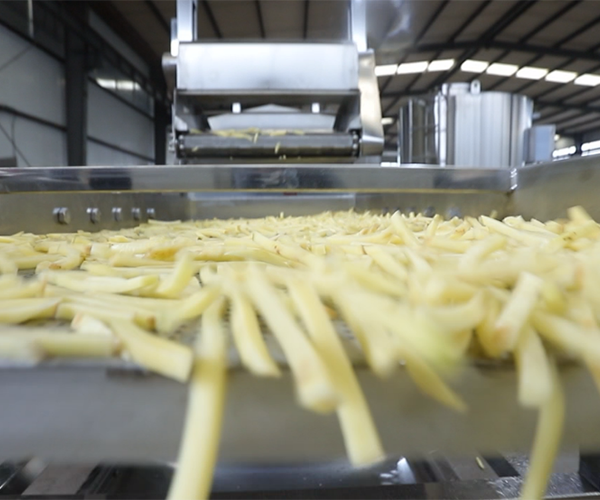
Step-by-Step Processing Flow of a French Fries Production Line
Raw Potato Preparation and Quality Requirements
Raw material quality directly affects the final product. A French Fries Production Line depends heavily on consistent potato input. If raw potatoes vary too much, the output becomes unstable. That is why manufacturers focus on size, internal composition, and storage control before processing begins.
In real production, suitable potatoes usually follow these standards:
Uniform Size and Shape: Potatoes should have a regular shape and similar diameter. This helps achieve consistent cutting results and reduces waste during trimming.
Balanced Dry Matter Content: Moderate dry matter improves texture after frying. It also reduces excessive oil absorption and keeps fries crisp on the outside.
Low Sugar Content: Lower sugar levels help avoid dark coloration during frying. It ensures fries maintain a light golden appearance.
Controlled Storage Conditions: Potatoes are often stored at regulated temperatures before use. This stabilizes internal composition and improves processing performance.
| Quality Factor | Recommended Condition | Why It Matters |
| Size & Shape | Uniform and regular | Ensures consistent cutting |
| Dry Matter | Stable and moderate | Improves texture and reduces oil |
| Sugar Level | Low | Prevents over-browning |
| Storage | Controlled temperature | Maintains internal quality |
Good raw material preparation helps the entire French Fries Production Line run smoothly. It reduces defects and improves final product consistency.
Cutting, Rinsing, and Blanching Process Explained
Once potatoes are prepared, they move into shaping and pre-treatment stages. These steps define the structure and visual quality of the fries. Small variations here can affect the entire production outcome.
The cutting process determines the final size and shape. Machines allow operators to adjust blade settings. This ensures uniform thickness across all strips. Uniformity improves both frying performance and product appearance.
After cutting, rinsing removes surface starch. This step is essential for improving texture. It also prevents fries from sticking together during later stages.
Blanching follows rinsing and prepares the fries for frying:
Cutting Adjustment: Blade settings control strip thickness and size. This ensures consistent cooking and improves product appearance.
Starch Removal Rinsing: Water flow removes excess starch from the surface. It improves texture and prevents clumping.
Blanching for Color Protection: Hot water treatment prevents oxidation. It helps maintain a clean, natural color after frying.
These processes work together to stabilize the product before moisture removal and frying.
Dewatering, Drying, and Frying Process
Before frying, reducing moisture is critical. Excess water can cause oil splashing and uneven cooking. That is why dewatering and drying are essential in a French Fries Production Line.
The process begins with mechanical dewatering. A vibrating system removes surface water quickly. Then, air drying removes remaining moisture using high-pressure airflow. This step improves frying efficiency and reduces energy consumption.
Frying is the core stage where flavor and texture develop. Automatic frying systems maintain stable conditions and support continuous production.
| Process Stage | Equipment Function | Benefit |
| Dewatering | Removes surface moisture | Prevents oil splashing |
| Air Drying | Reduces remaining water | Improves frying efficiency |
| Frying | Controlled oil heating | Develops texture and flavor |
Important features of frying systems include:
Temperature Control System: Adjustable temperature ensures consistent frying results. It helps maintain uniform color and texture.
Continuous Operation Design: Conveyor-based frying supports stable production flow. It reduces interruptions and increases efficiency.
Oil Filtration System: Built-in filtration keeps oil clean. It improves product quality and extends oil life.
These steps ensure fries are evenly cooked. They also help control oil absorption and overall product consistency.
De-oiling, Cooling, Seasoning, and Packaging
After frying, fries still contain excess oil and heat. Proper finishing steps are necessary before packaging or freezing. These steps directly affect taste, appearance, and shelf life.
De-oiling removes excess oil from the surface. This improves mouthfeel and reduces greasiness. Cooling follows to stabilize the fries and prepare them for further handling.
Seasoning may be applied depending on product requirements. Finally, packaging protects the product and prepares it for distribution.
De-oiling Process: Removes excess oil using centrifugal force or airflow. It improves taste and reduces heaviness.
Cooling Stage: Lowers product temperature before handling or freezing. It prevents sticking and structural damage.
Seasoning Application: Rotating drum ensures even coating of flavors. It maintains product integrity during mixing.
Automatic Packaging System: Handles filling, sealing, and optional nitrogen flushing. It protects the product and extends shelf life.
These final steps ensure that the fries are stable, flavorful, and ready for frozen food applications. Each stage contributes to delivering a consistent and high-quality final product.
Key Equipment in a Modern French Fries Production Line
Main Machines and Their Functions
A modern French Fries Production Line is built around a sequence of specialized machines. Each unit performs a defined task. Together, they create a stable and continuous workflow. When these machines are well integrated, they reduce product loss and improve overall efficiency.
Below is a structured overview of the core equipment and their roles:
| Equipment | Function | Impact on Production |
| Feeding Conveyor | Transfers raw potatoes into the line | Ensures smooth and continuous input flow |
| Washing & Peeling Machine | Cleans and removes potato skin | Improves hygiene and reduces manual labor |
| Cutting Machine | Cuts potatoes into uniform strips | Controls size consistency and cooking results |
| Blanching Machine | Heat-treats fries in hot water | Prevents discoloration and stabilizes texture |
| Frying Machine | Cooks fries at controlled temperature | Develops color, texture, and flavor |
| De-oiling Machine | Removes excess oil after frying | Improves taste and reduces greasiness |
| Seasoning Machine | Applies flavor evenly | Enhances product appeal and consistency |
| Packing Machine | Packs finished fries automatically | Protects product and improves efficiency |
To better understand how these machines work together, consider the following:
Integrated Material Flow: Conveyors connect each machine. They ensure continuous movement without delays. This reduces handling time and improves efficiency.
Multi-function Equipment Design: Some machines combine processes. For example, washing and peeling can occur in one unit. This saves space and reduces operational complexity.
Consistent Processing Results: Each machine is designed to handle uniform batches. This ensures stable output quality across long production cycles.
These machines form the backbone of the entire French Fries Production Line. Their coordination determines both efficiency and product quality.
Automation Features That Improve Production Efficiency
Automation is one of the most important factors in modern food processing. A fully automated French Fries Production Line reduces manual work and improves consistency across every batch.
Automation systems control key processing parameters. They help maintain stable conditions throughout the production cycle. This is especially important in frying and drying stages.
Here are the main automation features and their benefits:
Automatic Temperature Control: Frying systems maintain a stable temperature range. This ensures even cooking and prevents over- or under-frying.
Frequency Control Systems: Conveyor speed can be adjusted based on processing needs. This allows precise control over frying time and drying duration.
Continuous Operation Design: The line runs without interruption. It supports high-volume production and reduces downtime between batches.
To see how automation improves production, compare manual and automated systems:
| Feature | Manual Operation | Automated French Fries Production Line |
| Temperature Control | Operator-dependent | Precise and stable control system |
| Production Flow | Interrupted and uneven | Continuous and stable |
| Labor Requirement | High | Reduced |
| Product Consistency | Variable | Highly consistent |
Automation also improves safety and efficiency:
Reduced Labor Dependency: Fewer workers are needed to operate the line. This lowers labor costs and reduces human error.
Improved Process Stability: Machines follow preset parameters. This ensures consistent results across different production runs.
Better Resource Utilization: Energy and raw materials are used more efficiently. This lowers operational costs over time.
These automation features make the French Fries Production Line more reliable. They also support large-scale industrial production.
Capacity Options and Production Output
Choosing the right capacity is a critical decision for any manufacturer. A French Fries Production Line must match production goals, market demand, and available resources.
Modern production lines offer flexible capacity options. According to typical configurations, output can range from small-scale to large industrial production.
| Capacity Level | Output Range | Suitable For |
| Small Scale | 50–150 kg/h | Startups or pilot production |
| Medium Scale | 200–500 kg/h | Growing food businesses |
| Large Scale | 1000–2000 kg/h | Industrial manufacturers |
When selecting capacity, several factors should be considered:
Production Demand: Expected daily or monthly output determines the required line size. Choosing too small a capacity can limit growth.
Factory Space and Layout: Larger lines require more installation space. Proper layout planning ensures efficient workflow.
Investment Budget: Higher capacity lines require more initial investment. However, they often provide better long-term efficiency.
Future Expansion Plans: Selecting scalable equipment allows manufacturers to upgrade production without replacing the entire line.
Capacity is not just about output volume. It also affects efficiency, energy consumption, and labor requirements. A well-matched French Fries Production Line ensures stable production while supporting business growth.
How to Choose the Right French Fries Production Line for Frozen Food Manufacturing
How to Match Equipment with Product and Market Needs
Choosing the right French Fries Production Line starts with understanding your product and market positioning. Different markets demand different product types. Some focus on classic straight-cut fries, while others require crinkle cuts or specialty products made from alternative raw materials.
The production line must match both product type and expected output volume. A mismatch can lead to inefficiency, wasted investment, or unstable product quality.
Here is how manufacturers typically align equipment with their needs:
Product Type Matching: Straight fries, coated fries, or specialty cuts require different cutting systems and processing adjustments. It is important to select machines that support the desired product format.
Production Volume Planning: Small-scale operations may choose compact lines, while industrial producers need continuous high-capacity systems. Output requirements directly affect equipment size and configuration.
Raw Material Flexibility: A well-designed French Fries Production Line can handle not only potatoes but also sweet potatoes, cassava, or similar materials. This allows manufacturers to expand product offerings without changing the entire system.
| Selection Factor | What to Consider | Why It Matters |
| Product Type | Shape, thickness, product variation | Ensures correct machine configuration |
| Production Volume | Daily output and future growth | Prevents under- or over-investment |
| Raw Material | Potato, sweet potato, cassava | Improves flexibility and market reach |
A flexible production line gives manufacturers more options. It allows them to respond quickly to market trends and customer preferences.
Key Quality Factors to Evaluate Before Buying
Product quality is one of the most important factors when selecting a French Fries Production Line. Even with high capacity, poor quality output can damage brand reputation and reduce profitability.
Manufacturers should focus on the following quality indicators:
Thickness Uniformity: Consistent strip size ensures even frying. It also improves visual appeal and cooking performance for end users.
Surface Smoothness: Smooth surfaces reduce oil absorption and improve texture. Rough or uneven cuts can lead to inconsistent frying results.
Frying Color Consistency: Stable color indicates controlled processing conditions. It also reflects proper blanching and frying management.
Oil Content Control: Lower oil content improves taste and shelf life. It also makes the product more appealing to consumers.
Below is a simple quality evaluation framework:
| Quality Factor | Ideal Condition | Impact on Final Product |
| Thickness | Uniform across all fries | Even cooking and better texture |
| Surface | Smooth and clean | Reduced oil absorption |
| Color | Light and consistent | Improved visual appeal |
| Oil Content | Controlled and moderate | Better taste and longer shelf life |
To achieve these results, the production line must maintain stable processing conditions. This includes precise cutting, controlled blanching, and consistent frying temperature.
Additional considerations include:
Process Stability: Equipment should maintain consistent performance over long production runs. This reduces variation between batches.
Material Handling: Smooth transfer between machines prevents product damage. It also maintains uniformity.
Equipment Precision: High-quality components ensure accurate control of key parameters such as temperature and speed.
These factors help ensure that the French Fries Production Line delivers reliable and high-quality output.
Installation, Training, and Technical Support
Even the best equipment requires proper setup and operation. Installation and training are critical stages that determine how well the production line performs in real conditions.
Professional support from the supplier can make a significant difference. It helps reduce setup time and ensures that the system runs correctly from the beginning.
Key support elements include:
Installation Guidance: Suppliers often provide remote or on-site assistance. This ensures correct equipment assembly and system integration.
Commissioning Process: Initial testing and adjustment help optimize machine performance. It ensures all components work together smoothly.
Operator Training: Staff learn how to operate, maintain, and troubleshoot the equipment. This improves long-term efficiency and reduces downtime.
| Support Area | Service Provided | Benefit |
| Installation | On-site or remote guidance | Faster setup and fewer errors |
| Commissioning | System testing and adjustment | Optimized performance |
| Training | Operator instruction and practice | Improved efficiency and safety |
In addition, ongoing technical support is important:
Maintenance Guidance: Regular maintenance keeps machines running efficiently. It also extends equipment lifespan.
Troubleshooting Support: Quick response to technical issues minimizes production downtime.
Spare Parts Availability: Easy access to parts ensures continuous operation without long delays.
A strong support system ensures that the French Fries Production Line operates reliably. It also helps manufacturers maintain stable production over time.
Conclusion
An automatic French Fries Production Line improves efficiency and product consistency. It connects key processes into one smooth system. Star Bake provides reliable equipment with flexible capacity options. Their solutions support stable production and reduce labor costs. This helps frozen food manufacturers scale faster and maintain quality.
FAQ
Q: What is a French Fries Production Line?
A: A French Fries Production Line processes potatoes into fries through washing, cutting, frying, and packaging stages.
Q: How does a French Fries Production Line improve efficiency?
A: A French Fries Production Line automates processes, reduces labor, and ensures consistent output quality.
Q: What capacity options are available for a French Fries Production Line?
A: A French Fries Production Line ranges from small 50kg/h setups to large 2000kg/h industrial systems.
Q: Why is blanching important in a French Fries Production Line?
A: Blanching in a French Fries Production Line helps maintain color, improve texture, and prevent oxidation.
Q: How to choose the right French Fries Production Line?
A: A French Fries Production Line should match production needs, product type, and desired output quality.


