The industrial frozen produce market demands strict adherence to cellular preservation. Consumers expect frozen fruits and vegetables to match fresh produce in texture, color, and nutritional profile upon thawing. Achieving this standard requires highly specialized machinery designed to halt biological degradation instantly.
Legacy processing lines often suffer from thermal inefficiencies, inconsistent cut sizes, and slow freezing times. These operational bottlenecks lead to large ice crystal formation, cellular damage, drip loss, and compromised product quality. When cells rupture during a slow freeze, the structural integrity of the vegetable or fruit is permanently destroyed. You end up with a mushy texture once the product thaws on the consumer's counter.
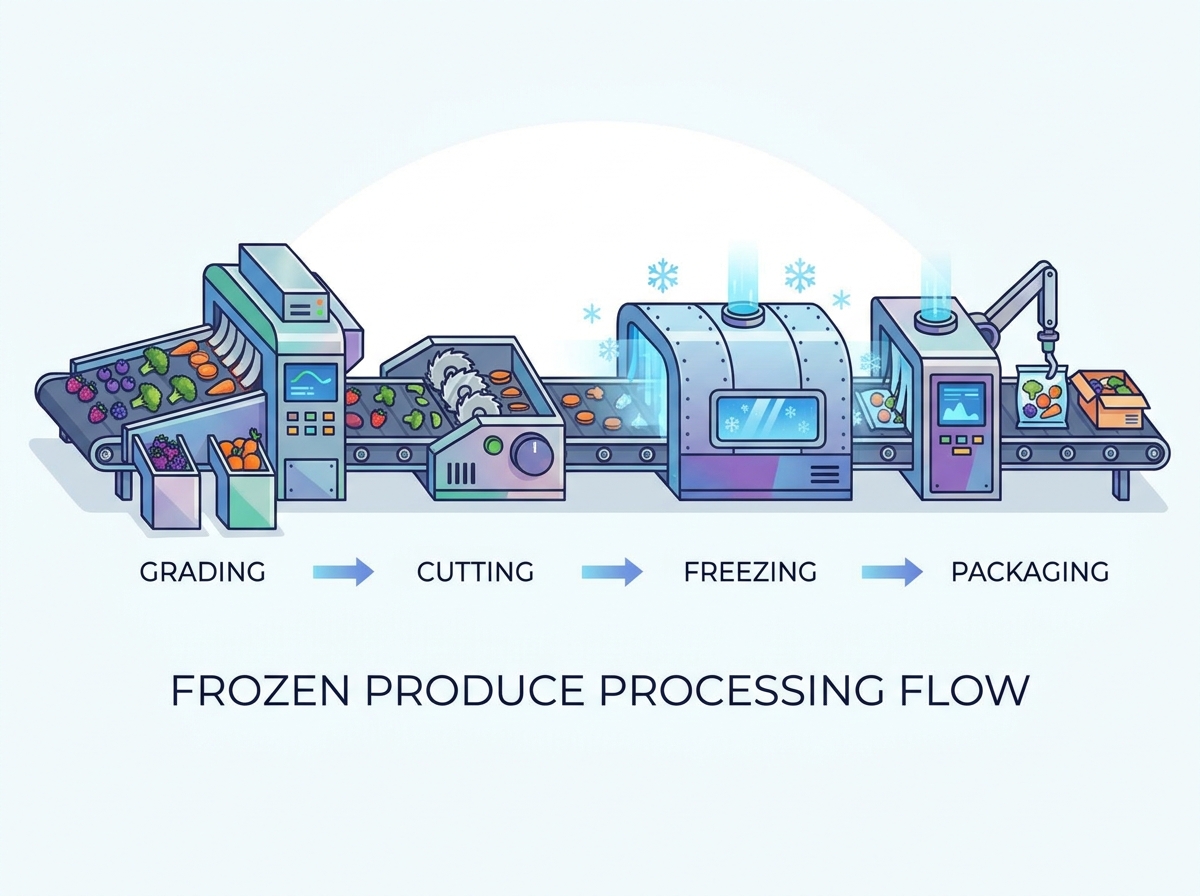
Upgrading or designing a high-yield production line requires a rigorous technical evaluation of modern frozen fruit and vegetable processing equipment. This guide breaks down the critical specifications for grading, cutting, freezing, and packaging machinery to maximize throughput and ensure food safety compliance.
Freezing Velocity Dictates Quality: Transitioning from conventional blast freezing to Individual Quick Freezing (IQF) or cryogenic systems reduces freezing time from legacy 18-hour cycles to mere minutes, preventing cellular degradation.
Pre-Processing Yields Matter: Advanced optical grading and precision cutting equipment minimize bruising, reduce waste, and ensure uniform freezing profiles.
Sanitary Design is Non-Negotiable: Equipment must meet stringent FSMA, FDA, and USDA standards, featuring clean-in-place (CIP) systems and crevice-free stainless steel construction to prevent microbial harborage.
Table of Contents
Toggle
Key Requirements for a Frozen Fruit and Vegetable Processing Line
Defining Quality Metrics and Cellular Integrity
The relationship between freezing speed and ice crystal size defines the ultimate quality of the final product. Rapid freezing ensures that the water inside the plant cells forms microscopic ice crystals. Slow freezing allows water molecules to migrate and form large, jagged ice crystals that puncture the cell walls. Upon thawing, these punctured cells leak moisture. This leads to significant drip loss and a degraded, soft texture.
Baseline success criteria for any facility include minimizing this drip loss, preserving structural integrity, and retaining vibrant color and natural flavor. Operators must target rapidly reaching core temperatures of -18°C (0°F) or lower. The faster the core reaches this threshold, the better the cellular preservation. We measure this in terms of heat transfer coefficients and retention time inside the freezing zone.
You must differentiate between food safety and food quality. Produce held continuously at 0°F remains microbiologically safe indefinitely, as bacterial growth is halted. However, cellular quality, texture, and nutritional value degrade over time if the initial freezing process was thermally inefficient. Equipment selection directly influences this initial thermal transfer rate.
Throughput vs. Facility Footprint Trade-offs
Evaluating the physical space requirements for continuous inline processing versus batch processing is a primary facility engineering task. Continuous inline systems offer superior throughput and consistency but require significant linear floor space. Batch processing can fit into tighter, modular spaces but often sacrifices overall volume capacity and introduces handling bottlenecks.
Facility managers balance high-capacity throughput, measured in tons per hour, against the required floor space for cooling tunnels, wash flumes, and spiral freezers. Vertical spiral freezers utilize overhead space to maximize retention time while minimizing the footprint. They are ideal for facilities with limited square footage but high ceiling clearance. You must calculate the exact belt loading capacity based on the bulk density of the specific vegetable or fruit.
Sanitary Design and Food Safety Compliance
Hygienic engineering standards dictate the physical construction of processing machinery. Equipment must feature IP69K washdown ratings. This allows components to withstand high-pressure, high-temperature chemical cleaning. Sloped surfaces are mandatory to prevent water pooling. Standing water acts as a breeding ground for Listeria and other pathogens. The elimination of hollow tubing in structural frames removes hidden harborage points for bacteria.
Automated Clean-in-Place (CIP) systems minimize changeover times and cross-contamination risks. CIP systems circulate cleaning and sanitizing chemicals through the internal components of the machinery without requiring manual disassembly. This ensures repeatable, verifiable sanitation cycles. It keeps the line compliant with stringent regulatory standards while maximizing production uptime.
How to Choose Pre-Processing and Grading Equipment
Washing, Blanching, and Cooling Systems
Industrial washing flumes are engineered for aggressive soil and pesticide removal without damaging fragile produce. Hydro-dynamic flumes use controlled water flow and air agitation to gently scrub delicate items like berries and leafy greens. Heavy root vegetables require more robust rotary drum washers to remove stubborn field debris. Water filtration systems must run continuously to remove suspended solids and maintain flume water clarity.
Blanching equipment provides precise thermal control to deactivate degrading enzymes, specifically lipoxygenase and peroxidase. If left active, these enzymes cause off-flavors and browning during frozen storage. Steam and hot water blanchers must maintain exact temperature and retention time parameters. This achieves enzyme deactivation while preventing the produce from overcooking and losing its structural firmness.
Integration of rapid chilling systems post-blanching is non-negotiable. Once the produce exits the blancher, it must be immediately shocked with cold water or chilled air to halt the cooking process. Failure to rapidly cool the product results in a mushy texture. It also increases the thermal load on the downstream freezing equipment, wasting massive amounts of refrigeration energy.
Optical Sorting and Defect Removal
Mechanical grading relies on physical sizing screens and diverging rollers. These are effective for basic sorting but fall short on quality control. Advanced optical and laser sorting technologies utilize high-definition cameras and near-infrared sensors. They inspect every individual piece of produce on the belt at high speeds.
Automated defect removal identifies foreign materials, unripe green produce, color inconsistencies, and bruised or mechanically damaged items. High-speed pneumatic ejectors blast defective items off the line in milliseconds. This protects downstream equipment from damage. It ensures that only premium-grade produce reaches the freezer, directly impacting the final product grade and market value.
How to Choose Fruit and Vegetable Cutting Equipment
Precision Slicing, Dicing, and Halving
Cut uniformity directly impacts freezing efficiency. Uniform sizes freeze at the exact same rate. If cuts are inconsistent, smaller pieces will freeze too quickly and suffer from freezer burn. Larger pieces will remain under-frozen in the center, leading to cellular damage and spoilage risks during storage.
Cutting mechanisms must be selected based on produce density. Root vegetables require heavy-duty, high-torque dicers with rigid blade assemblies to power through dense fibers. Soft fruits, such as strawberries or peaches, require ultra-sharp, thin-profile slicing wheels. These slice cleanly without crushing the delicate cellular structure.
Cutting Technology
Produce Type
Blade Configuration
Primary Advantage
High-Torque Dicer
Carrots, Potatoes, Beets
Rigid, thick-gauge stainless steel
Handles high-density fibers without stalling
Rotary Slicer
Strawberries, Zucchini, Cucumbers
Thin-profile, razor-edge wheels
Prevents cellular crushing and juice loss
Waterjet Cutter
Asparagus, Celery
High-pressure water stream
Zero mechanical blade wear, highly sanitary
Blade Durability and Yield Optimization
Evaluating blade metallurgy and tensioning systems reduces bruising and cellular tearing during the cut. High-carbon stainless steel blades hold a sharper edge longer. They deliver clean cuts that seal in moisture. Dull blades crush the produce, causing immediate juice loss and reducing the overall yield weight before the product even reaches the freezer.
Maintenance requirements heavily influence operational uptime. Quick-release cutting heads allow for rapid blade changeover speeds. Facilities must establish strict sharpening intervals and maintain an inventory of replacement parts. The cutting equipment must never operate with compromised blades.
Inspect blade tension daily before the first production shift begins.
Measure cut uniformity every two hours using digital calipers on a random sample.
Replace slicing wheels after 40 hours of continuous operation on dense root vegetables.
Sanitize all cutting head assemblies using a dedicated CIP cart during product changeovers.
How to Choose the Right Freezing Technology
Individual Quick Freezing (IQF) Systems
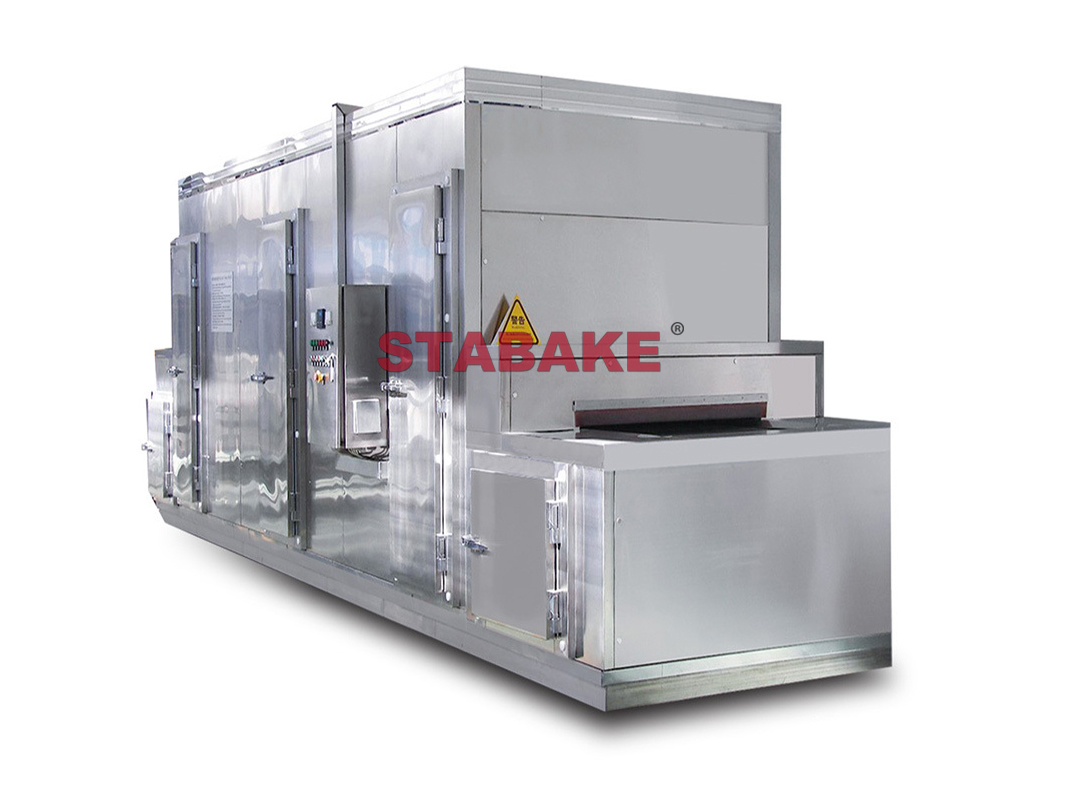
IQF tunnels utilize fluidization via high-velocity cold air to process peas, berries, and diced vegetables. As the product enters the tunnel on a perforated conveyor belt, powerful fans blast sub-zero air upward through the belt. This air lifts and suspends the individual pieces of produce. They freeze rapidly while floating in the cold air stream.
Bed design and airflow control prevent product clumping and ensure individual separation. Adjustable fan speeds allow operators to tune the fluidization based on the weight and moisture content of the specific produce being run. Modern IQF equipment features continuous processing capabilities and advanced coil designs. These maximize energy efficiency while extending the time between defrost cycles.
Cryogenic Freezing and Chilling
Cryogenic systems utilize liquid nitrogen (LIN) or carbon dioxide (CO2) for the ultra-fast freezing of high-value, fragile, or high-moisture products like raspberries and sliced mushrooms. The consumable gas is sprayed directly onto the product. It absorbs heat instantly as it expands and vaporizes.
Cryogenic chilling serves as an excellent pre-cooling step to boost the capacity of existing mechanical freezers. By crust-freezing the outer layer of the produce with cryogenics before it enters a mechanical spiral freezer, operators lock in moisture. This prevents clumping and significantly increases the overall throughput capacity of the line.
Mechanical Spiral and Blast Freezers
Mechanical spiral freezers are highly effective for bulkier items or products that are already packaged. The continuous belt spirals upward or downward inside an insulated enclosure. This provides a long retention time in a compact footprint. Thick items freeze thoroughly to the core without requiring massive linear floor space.
Traditional blast freezing involves placing pallets of produce into a static cold room. This method suffers from extended 18-hour freezing cycles. It leads to massive ice crystal formation and severe cellular degradation. Blast freezing remains viable only for specific scenarios, such as freezing bulk puree drums or raw materials destined for heavy downstream processing where cellular texture is irrelevant.
Frozen Fruit and Vegetable Weighing and Packaging Systems
Multi-Head Weighers and Dosing Systems
Multi-head weighers must operate flawlessly in sub-zero, high-moisture environments. These automated scales calculate the exact combination of hoppers needed to hit the target weight for each bag. Accuracy avoids product giveaway while ensuring regulatory compliance with stated package weights.
Handling frozen, frost-prone products requires specialized anti-stick coatings. Dimpled stainless steel surfaces and customized vibration profiles prevent wet or frosty produce from bridging or clumping in the feed pans. This ensures a continuous, smooth flow of product into the packaging machinery.
Vertical Form Fill Seal (VFFS) Integration
VFFS machinery forms bags from a continuous roll of film, fills them with the weighed produce, and seals them in one fluid operation. Specifications for handling polyethylene (PE) and laminated films are critical. The packaging material must remain flexible and durable during prolonged frozen storage without shattering.
Seal integrity technologies utilize heated jaws with precise pressure controls to prevent freezer burn and ensure cold-chain durability. A weak seal allows cold, dry air to enter the bag, drawing moisture out of the produce and ruining the quality. Integrating automated case packing and robotic palletizing at the end of the line ensures cases are built quickly and accurately for immediate transfer to cold storage.
End-of-Line Cold Storage Integration and Inventory Management
Packaged products must be immediately transferred to holding freezers maintaining -18°C (0°F) or colder. Any delay on the loading dock allows partial thawing. Even slight temperature fluctuations cause the microscopic ice crystals to melt and recrystallize into larger, damaging formations.
Implementing automated First-In, First-Out (FIFO) palletizing and storage systems manages inventory effectively. Prolonged freezer storage impacts cellular quality over time due to slow moisture migration, even when strict food safety parameters are maintained. FIFO ensures products are shipped while at their peak quality.
Frozen Produce Line Installation Risks and Solutions
Scalability and Modular Upgrades for Growing Operations
Equipment flexibility is vital for operations transitioning from small-scale output to high-volume industrial production. Rigid systems that cannot be expanded force companies to replace entire lines prematurely. Modular processing equipment allows for phased capacity expansion.
Adding tunnel modules to an existing IQF line or extending the length of a wash flume provides scalable growth without requiring a complete system overhaul. Facility engineers must select machinery with standardized footprints and expandable PLC control architectures to future-proof the processing floor.
Energy Consumption and Utility Requirements
Refrigeration loads and the electrical consumption of high-powered fans represent massive utility draws. Mechanical freezing systems require substantial electrical infrastructure. Cryogenic systems demand complex gas supply logistics and bulk storage tanks on-site.
Integrating energy recovery systems captures waste heat from the refrigeration compressors. You repurpose it for heating wash water or facility spaces. Utilizing variable frequency drives (VFDs) on all pumps and fans allows the equipment to scale power consumption based on the exact real-time load, mitigating wasteful utility usage.
Integration Challenges with Legacy Lines
Pairing high-speed IQF freezers with older, slower packaging or cutting equipment creates immediate operational bottlenecks. If the freezer processes five tons per hour but the legacy bagger can only handle three tons, the entire line is restricted. Product backs up on the belts.
Mitigation strategies require conducting comprehensive line audits before purchasing new machinery. Implementing centralized PLC and SCADA controls ensures that all machines communicate and adjust speeds synchronously. Phased equipment upgrades must be carefully planned to match throughput capacities across all processing stages.
Conclusion
The optimal setup hinges on balancing the biological needs of the specific produce with facility constraints, scalability requirements, and throughput goals. Prioritize equipment vendors based on their ability to prove yield retention, hygienic design certifications, and energy efficiency through empirical data. Choose cryogenic systems for premium or fragile lines and mechanical IQF for high-volume, continuous bulk processing.
Based in Jinan, Shandong Province, Stabake is a specialized food processing equipment manufacturer offering individual machines and turnkey production-line solutions for fruit and vegetable processing. The company supports customers with process planning, machine selection, OEM and ODM customization, installation, commissioning, maintenance, and spare-parts services, helping processors build production lines suited to their products, capacity targets, and factory conditions.
Initiate a technical audit of current line bottlenecks to identify specific machinery limiting your throughput.
Request pilot testing with shortlisted equipment manufacturers using your actual produce to verify freezing times and cut quality.
Standardize your facility's hygienic requirements to ensure all new equipment meets IP69K washdown ratings and includes automated CIP capabilities.
Calculate the exact floor space and ceiling clearance available before finalizing any spiral freezer or IQF tunnel dimensions.
FAQ
Q: What is the ideal freezing temperature for industrial fruit and vegetable processing?
A: Industrial systems aim to rapidly bring the core temperature of the produce to -18°C (0°F) or lower. Fast freezing to this temperature minimizes the size of ice crystals, which protects the cellular structure of the food.
Q: Does freezing temperature affect food safety or just food quality?
A: Frozen foods kept continuously at 0°F (-18°C) remain microbiologically safe indefinitely. However, the speed of the initial freeze and the consistency of storage temperatures dictate the quality—specifically texture, color, and flavor retention.
Q: What is the difference between IQF and cryogenic freezing equipment?
A: IQF typically uses mechanical refrigeration and high-velocity cold air to fluidize and freeze products continuously. Cryogenic freezing uses consumable liquid nitrogen or CO2 for significantly faster freezing times, ideal for highly fragile or premium produce.
Q: How does cutting equipment impact the freezing process?
A: Precision cutting equipment ensures uniform size and shape, which is critical for consistent freezing rates. Irregular cuts lead to uneven freezing, where smaller pieces may suffer freezer burn and larger pieces may not freeze quickly enough, causing cellular damage.
Q: What are the key sanitary requirements for frozen produce processing lines?
A: Equipment must feature IP69K washdown-rated components, sloped surfaces to prevent water pooling, continuous hygienic welds, and automated Clean-in-Place (CIP) systems to comply with FSMA, FDA, and USDA regulations.
Q: Can cryogenic chilling be added to an existing mechanical freezing line?
A: Yes. Cryogenic chilling equipment can be installed upstream of an existing mechanical freezer to rapidly crust-freeze the product. This prevents clumping, seals in moisture, and increases the overall throughput capacity of the existing line without requiring a full system replacement.